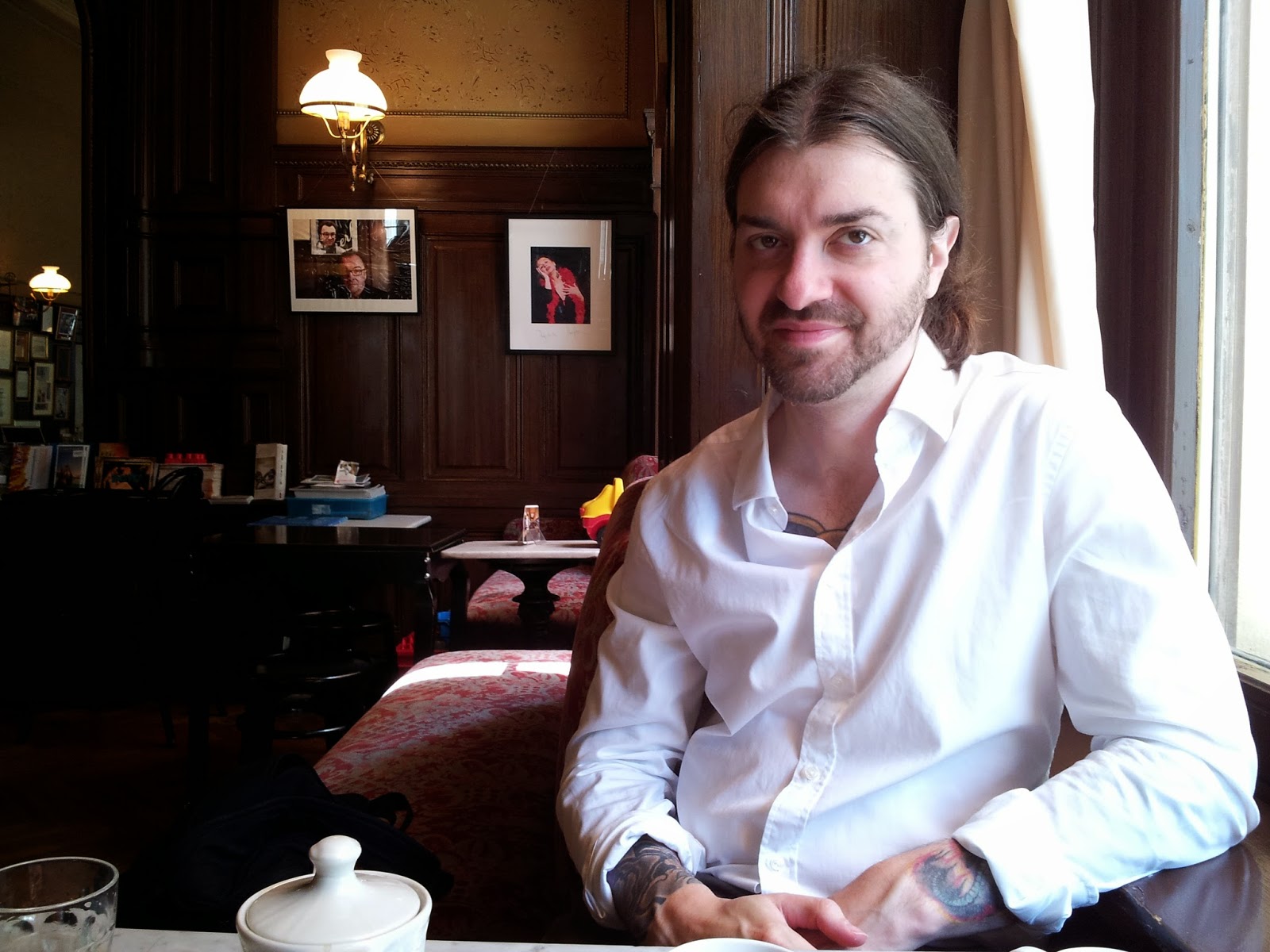
Friday, 21 November 2014

My reflections on the "Newer Researchers in Folklore Conference", Warburg Institute

Yesterday, I had the pleasure of being invited to attend the “Newer Researchers in Folklore Conference”, organised by The Folklore Society and held at their central London base in the Warburg Institute, Bloomsbury. As many have expressed with some trepidation, all is not well for English folkloristics; while we have seen the University of Chichester open its Sussex Centre for Folklore, Fairy Tales and Fantasy, the past decade has witnessed the closure of other departments devoted to the field. In the academic sphere, folkloristics is rarely accorded the respect and recognition that it deserves, and indeed in many cases is barely visible and very poorly understood. Further, folklore itself is widely associated with Morris dancers, Maypoles, and all things twee, rather than being understood as encompassing all of the popular beliefs, customs, and traditions of any given society; the "lore of the folk", if you will. Understandably, this sorry state of affairs is one that greatly concerns the Folklore Society, and it is was clear that one of the core purposes behind this conference was to find a way to reverse this decline and inject new life into this fascinating old discipline.

Organised by Dr. Matthew Cheeseman and Dr. Paul Cowdell (the latter of whom could unfortunately not be at the event itself), the one-day conference was also attended by the Society's President, Professor James H. Grayson, as well as its Vice President Robert McDowall and prominent British folklorist Jeremy Harte, while Dr. Caroline Oates kindly dealt with the organisational issues surrounding food and drink. However, these eminent scholars were not to take centre stage, for as its name suggests, the day was devoted to "newer researchers", which in many, although by no means all, cases was a synonym for "younger researchers". Certainly, the majority of us in attendance were either in the midst of our doctoral research or stepping out into the daunting early stages of an academic career. Although I recognised a few familiar faces from earlier folklorist events, this was nevertheless the first time that so many of us in these early stages of academia had been brought together in one place to discuss the field and our role in it.

Our opening keynote speaker was Professor Diane Goldstein, the director of the University of Indiana's Folklore Institute, one of the foremost departments for folkloristics in the United States. In her talk, she outlined the academic opportunities that were open to folklorists in her own part of the world, championing the term "folklorist" as a badge of pride and suggesting that as a discipline, folkloristics can be differentiated from sociology as a result of its ideological bent. Suggesting that better days for folklore studies may well be on the horizon, she provided a number of useful suggestions for how those here in England can galvanise to improve conditions for the discipline and bring it up to the standard present in much of North American and Europe. This was followed by a talk from a representative of publishing company Taylor & Francis, who produce the Folklore Society's peer-reviewed journal, Folklore. As could be expected, some comments were raised regarding the ethical problems of author-financed open access services, something which has attracted a lot of attention, at least in Anglo-American academia, over the past few years.

After lunch, we embarked on a series of presentations, in which we each introduced our research, future plans, and our own relationship to folklore. First up was Gunnella Thorsgeirsdottir, an Icelandic scholar who has recently completed her doctoral research into the folk beliefs and practices surrounding pregnancy and childbearing in Japanese society.  She was followed by Bristol-based independent scholar and journalist Gideon Thomas, who discussed his interests in Anglo-American folk musical traditions. Next was Dr. Will Pooley, a post-doctoral fellow at the Institute of Historical Research who specialises in traditional culture within the Francophone world. He was followed by a scholar with whom I co-organised last year's third "Popular Antiquities: Folklore and Archaeology" conference, Dr. Tina Paphitis, who has recently completed her work on the folklore of archaeological landscapes in Britain. Taking quite a different approach to the study of folklore was Dr. Victoria Newton, who is presently a Research Associate at the Open University; her specialism is in popular beliefs surrounding women's contraception and fertility in contemporary Britain. Next up was Éva Gyöngy Máté, a Hungarian doctoral candidate at the University of Debrecen who has been looking at the mediality of landscape in contemporary Scottish fiction.

Doctoral student Melanie Lovatt proceeded with an introduction to her work with individuals living in old age homes from a perspective rooted in material culture studies. She was followed by independent scholar Alice Little, who outlined her research into both musical instruments in museums and on historical folklore collectors like Percy Manning. French-American doctoral student Nicolas de Bigre proceeded with an outline of his work with immigrant communities in North-East Scotland, focusing on their personal-experience narratives of being an immigrant. Next was Ben Kehoe, whose recent master's degreee thesis examines late nineteenth-century Sicilian popular perceptions of Giuseppe Garibaldi and the Revolution of 1860. Heading back to the U.K., Ceri Houlbrook discussed her approach as a "folklore archaeologist" in analysing the fascinating tradition of coin trees in modern Britain. Social historian Erika Hanna then offered us a discussion of her work in analysing Dublin's Urban Folklore Project, which was carried out from 1979-80. Adopting a very different approach was independent scholar Michelle Griffiths; herself a performance artist, she has been looking for new avenues in which to combine folklore and artistic expression. After I then outlined my own research projects into both Anglo-Saxon belief systems and the contemporary Pagan use of archaeological monuments, paying particular attention to my use of folkloric sources, Cheeseman then rounded the day off with an outline of his doctoral research in the folklore of student life.

The conference provided a fantastic opportunity to bring together newer researchers who are all, in one way or another, embarking on studies within the remit of folkloristics. We were able to meet one another, learn of each other's research, and discuss our shared concerns and obstacles, as well as potential ways of dealing with them. In doing so, it was undoubtedly of great value to the field. However, what became particularly apparent was that few, if any of us, identified solely as a folklorist. Instead, we tended to think of ourselves as scholars of archaeology, history, sociology, or literary studies first and foremost, and as a folklorist second, third, or even fourth. Some, including myself, were even hesitant about labelling ourselves "folklorists"; in part this was because most of us lacked in-depth academic training in the methodologies and theoretical perspectives of folklore studies, but also because there are few if any academic positions in English academia for a self-described folklorist. Conversely, others, not least Professor Goldstein herself, urged us to proudly label our best work as "folklorist", thus hoping that greater academic exposure and impact will result in an improved future for the field. I hope that she's right, and (for better or worse) I will certainly be more comfortable in declaring myself a folklorist in future.

UCL Events' review of my recent Petrie Museum lecture

For those who missed my recent lecture at UCL’s Petrie Museum on the subject of archaeology and occultism in the films of American experimental filmmaker Kenneth Anger, you might wish to check out a review here, authored for the UCL Events’ Blog.

Friday, 31 October 2014

A Halloween Review: Michael Howard and Daniel Schulke's "Hands of Apostasy: Essays on Traditional Witchcraft" (Three Hands Press, 2014)

Today – October 31st – is a date observed across the Western world as Halloween, a festival with ancient origins which over the years has come to be associated with ghouls, ghosts, and witchery. In honour of this remarkable day, one which seems to bring together fun, frolic, and fear in equal measure, I offer a thematically-appropriate book review here at Albion Calling. Although in the past my reviews have appeared only in academic journals, I have decided to follow the lead of award-winning scholar of Western esotericism Egil Asprem by posting a review directly to my own blog, where it will be available freely to a far wider audience than that normally received by peer-reviewed outlets. My decision to do so was sparked by the publisher's invitation to review one of their recently-released esoteric tomes that fits very much within the remit of one of my primary research interests: the historical development of modern religious Witchcraft in Britain and the West more widely.


Hands of Apostasy: Essays on Traditional Witchcraft
 has been published by Three Hands Press, one of the two publishing arms of the Cultus Sabbati, an occultist “Traditional Witchcraft” group established in the early 1990s by the Essex occultist Andrew D. Chumbley (1967–2004). Chumbley claimed to have been initiated into a number of pre-existing British folk magical traditions, whose teachings formed the partial basis from which he formed the Cultus, before he went on to gain widespread attention within the Western esoteric milieu for authoring a number of particularly influential grimoires, most notably The AzoëtiaQutub, and ONE: The Grimoire of the Golden Toad. In later life, he entered academia as a historian of religion, although tragically died while carrying out his PhD research. Both of the editors of this particular anthology had strong links to Chumbley; Michael Howard was a close personal friend of his, having previously established himself as a well-known figure in the British occult scene for editing and publishing The Cauldron, a popular practitioner-oriented journal devoted to witchcraft, folklore, and paganism, since 1976. The U.S.-based Daniel Schulke, meanwhile, was an initiate of Chumbley's Cultus who took on the mantle of the group's Magister (effectively its leader) after its founder's untimely passing, a position that he retains to this day.

Thus, rather than being the product of a scholarly press, Hands of Apostasy is a tome that has been both edited and published by an occult organisation. In keeping with this, its chapters have been (primarily) written not by “outsider” academics but by occultists themselves, “insider” voices who here discuss the very traditions to which they owe their spiritual allegiance. While I am therefore accustomed to reviewing academic books using the usual benchmarks and standards of academia, here I must attempt to do something different; to review a non-academic work of esotericism from my own perspective as an academic non-esotericist. It would be simply unfair if I were to therefore challenge the contents of this book for being insufficiently academic, because they were never designed to be so in the first place; instead I shall seek to evaluate the varying chapters on their own merits, with critical commentary from my own (somewhat different) position.

The Introduction

In the anonymously authored introduction – which can most probably be attributed either to Mr. Howard or Mr. Schulke, if not both of them – the reader is offered such an insider view of the “Traditional Craft”, or “Old Craft” as it is also often known. Here, it is described as “a distinct body of archaic magical practices in present-day Britain and North America, which despite ties to past milieus of magic also thrive within modern spiritual climes” (9). Emphasising that it is not a singular, monolithic entity, the author(s) state that these groups emerge from “a variety of historical magico-religious streams” but that they typically “operate in secret, with strict means of initiatic succession, and practice sorcery characterized by a dual ethos of healing and harming” (9–10). Following this, we are given a brief introduction to a few of the figures whom they see as central to the public dissemination of knowledge on the Traditional Craft, before an outline is provided into the Luciferian world view which many contemporary Crafters – and in particular the members of the Cultus Sabbati – embrace.

A point that I found particularly interesting was that the author seeks in part to define Traditional Witchcraft by explaining what it is not. To their mind, it is “very different in form, ethos and nature” from the “neo-pagan witchcraft” (10) which was pioneered by the English occultist Gerald Gardner in the 1950s, and which in the Alexandrian milieu of the coming decade came to be emblazoned under the somewhat less incendiary name of “Wicca” (on the etymological development of the word see Doyle White 2010). While I would certainly concur that there are some groups flying the banner of the “Old Craft” whose beliefs and practices do indeed differ greatly from those of Gardnerian Wicca and its offspring – the Cultus Sabbati being perhaps the most prominent example – I do not share the belief that all so-called “Traditional Witches” differ so clearly from Gardner's creation. As I have argued elsewhere (Doyle White 2013), textual evidence for the original theology present in the 1960s coven of Robert Cochrane – a man often treated as the “Traditional Witch” par excellence – depicts a magico-religious tradition that is very much Neopagan in form and content, and that is before one takes into account the compelling evidence that Cochrane himself was also a Gardnerian initiate (see Doyle White 2011). 

Furthermore, it is also evident that the terms “Old Craft” and “Traditional Witchcraft” have come to be embraced by practitioners in various parts of the world whose traditions are quite evidently variants of eclectic Wicca; I am reminded of a passage on page 385 of The Triumph of the Moon in which Professor Ronald Hutton recalls knowing of three covens which established themselves as “Wiccan” in the 1980s, only to switch to declaring themselves practitioners of the “Traditional Craft” in the 1990s. Clearly, for the author of this introduction – as for many Traditional Crafters – the boundaries between Wicca and the Old Craft are, despite a little interaction and mutual influence, comparatively crisp and clear. Etically speaking, I cannot share that view; I see the term “Traditional Craft” as more of a legitimation strategy, a way for certain magico-religious and esoteric groups to hark back to the pre-Gardnerian practices of an older Europe, to a historical “tradition” of witch bottles, cunning folk, and Horse Whisperers, as a means of conjuring up a sense of authenticity, pedigree, and heritage. Some of these groups perhaps do have such roots – Chumbley's Cultus and the Sabbatic Craft it espouses being the most prominent example – but others I suspect owe far more to Gardner's legacy than to those of his antecedents.

The Chapters 

In the coming chapter we are treated to an article by Chumbley himself on the subject of “The Magic of History”, in which he offers a fascinating personal insight into how he saw himself as embodying “a bridging position” (21) between the world of the historian and that of the magician. In doing so, he discusses both the “history of magic” and “magical history”. While the former offers a fairly simple analysis of textual information placed within a chronological framework, the latter does something quite different, instead tapping into a “timeless” zone through which he believed he could communicate via “spirit-discourse” with the shades of long-deceased magicians (20). As he aptly notes however, “such truth-claims [attained from this zone] cannot be presented as historical evidence, however[...] such truth-claims must be respected by scholarship and treated impartially as the beliefs of a given individual or tradition” (20), thus championing methodological agnosticism among scholars of magic. In doing so, he offers us an intriguing theoretical approach to the analysis of living esoteric and magico-religious traditions that warrants greater attention from those of us who are active in this field.

A further aspect of this chapter which I found particularly interesting was Chumbley's suggestion that some of the cunning-folk of mid-to-late nineteenth-century Britain formed together in lodges or covens, and that the descendants of some of these groups have survived to this day, coming to be unified under the banner of “Traditional Witchcraft”. He further suggests that from at least the 1890s, a number of these groups began to actively incorporate elements from the Early Modern iconography of the Witches' Sabbath into their practices. As evidence for this, he comments on his own encounters and experiences with such groups; at the same time, he comments that their secrecy prevents them from opening themselves up to academic scrutiny and study, and that he himself was at times frustrated by this impasse. As he acknowledges, those of us in academia are thus left in a conundrum; (not implausible) claims are being made about nineteenth-century magical practices and their continued survival to this day, but the information that historians require to analyse such claims are being intentionally kept sub rosa. As an academic, I found this a particularly interesting chapter, and feel that it really serves to reiterate what a loss Chumbley was for scholarship in the field of magic.

Chumbley's chapter is followed by a short piece authored by the late American esotericist Douglas McIlwain, in which he lays out his claims to having been initiated into a magico-religious tradition by his great-uncle in 1967 which he himself termed the “Skull and Bones Family Tradition”. As a first-hand testimonial to forms of American folk magic it is truly fascinating but unfortunately – as with so many similar claims – its veracity can (and indeed, from a scholarly perspective, must) be questioned. Remaining in the United States, Corey Thomas Hutcheson then provides us with a comparison of traditional witchcraft lore in the mid-to-southern Appalachians with that of the Ozarks, highlighting how both have identifiable origins in the folk beliefs of Europe but each nevertheless diverged and developed in independent directions prior to being recorded by early twentieth-century folklorists. 

David Rankine then returns us to the Old World to argue that the grimoire tradition of Medieval and Early Modern Europe was influenced in various ways by witchcraft. Although an intriguing subject worthy of further in-depth research, it was unfortunate that Rankine did not explicitly outline what he meant by the term “witchcraft”, seemingly including a wide variety of phenomena – including benevolent folk magical charms – under that category, something which most scholars would critique. A brief piece from the late Cecil Williamson, founder of the Boscastle Museum of Witchcraft, is then included, in which he discusses aspects of what he terms “moon-raking rites” in British folk magic. Again, it's very interesting as a document of potential twentieth-century folk practices, but given Williamson's well known habit of bending the truth, such claims have to be taken with a pinch of salt. The anthology then continues with a lengthy chapter from Martin Duffy in which he offers an insider discussion of the esoteric, and often sexual, symbolism of the cauldron. In doing so, he references a wide array of disparate sources, from the iconography of Early Modern diabolical witchcraft to Iron Age archaeology and from the writings of modern Traditional Witches to Afro-Cuban magico-religious practices; this reflects a widespread belief among Traditional Crafters – as among many occultists and esotericists more widely – that there are common magical and occult meanings behind traditions that are otherwise scattered across very different historical and cultural contexts.

Melusine Draco of the Coven of the Scales follows with a discussion of her group's animistic worldview, in which Britain's rural landscape is understood as being populated by an array of genii loci, or spirits of the place, whom she believes can be contacted through Old Craft practices. Asserting that these traditions therefore represent the survival of pre-Christian British shamanism, her claims regarding ley-lines being marked by late prehistoric megaliths seemingly owe more to the mid-twentieth century Earth Mysteries movement than older folk traditions, something that certainly raised the eyebrow of this particular archaeologist. Howard then offers us a historical overview of necromancy – the act of contacting the spirits of the dead – throughout European history, ranging from archaeological interpretations regarding ancestor cults in Neolithic Europe through to Roman, Medieval, and Early Modern textual accounts and on to the necromantic rites of Traditional Witches. In the ensuing chapter, Peter Hamilton-Giles offers an intriguing discussion of the “witching hour”; in a manner echoing the aforementioned Chumbley chapter, he stresses the difference between the historian's perception of time and the magical practitioner's perception of time with its ties to the idea of personal spiritual truth. Gemma Gary of the Cornish Ros An Bucca group follows with her discussion of “The Man in Black”, or Devil, in European witchcraft, in doing so making extensive reference to the accounts of the Early Modern witch trials and subsequent Modern textual and folkloric accounts of magico-religious groups such as the Toad Witches.

We are then presented with a second offering from Chumbley himself, this time on the origins and rationales of modern Witch-cults. Aptly highlighting that there were magico-religious groups operating prior to the emergence of Wicca which termed themselves “Witches” – most notably the Toad Witches and the Zos Kia Cultus of Austin Osman Spare – he proceeds to discuss the origins of Gardnerian Wicca, seemingly accepting the possibility that Gardner had indeed been initiated into a pre-existing New Forest coven, which represented an older tradition of magic, but that the "Father of Wicca" had then gone on to radically alter this tradition according to the witch-cult hypothesis of Margaret Murray. From there, Levannah Morgan provides a beautifully written personal account of her own experiences with the use of a mirror as a magical tool, rooted in the folk magical traditions which she encountered growing up in rural Wales during the 1960s. Heading into the Irish Sea, we then arrive at the Isle of Man, where a collaborative group known only as Manxwytch discusses some examples of accounts of alleged witchcraft and folk magical customs on the island, before suggesting that these exerted some influence on Gardner, who lived on the island in later life. From Europe's north-west to its south-east, we are then offered a chapter on Serbian “traditional witchcraft” from Radomir Ristic which looks in particular at a rite known as “Unchain the Devil”. Although an interesting account of a folk magical practice that apparently still continues in Serbia, I was a little sceptical as to the unproven assertion that it had its origins in “pre-Christian paganism and Gnosticism” (247), something which appears to represent an approach rooted in the discredited doctrine of folkloric survivalism.

From my own perspective, more satisfying is the following chapter, authored by Jimmy Elwing – co-editor of Correspondences: An Online Journal for the Academic Study of Western Esotericism – on the basis of the work conducted for his recent master's thesis at the University of Amsterdam. Devoted to an analysis of Chumbley's work, it discusses how he constructed and legitimised his Sabbatic Craft, before examining the Magister's ideas pertaining to dream-like states of consciousness as a gateway to gnosis. Although other essays have seen publication discussing Chumbley and his work (for instance Morris 2013), Elwing's work here represents one of the very first scholarly examples to do so, and thus will no doubt be of great help for future researchers venturing into this area.

Italian-American Witch Raven Grimassi follows with a discussion of the traditional associations between witches and botanical knowledge, looking in particular at the case of the mandrake root and the connection between witchery and the forest. Switching focus to the Welsh Marshes, Gary St. Michael Nottingham provides a fascinating discussion of surviving examples of local folk magical charms, which are – as he notes – without exception rooted in Christian sources. The penultimate chapter is provided by Schulke himself, and examines conceptions of darkness within Traditional Witchcraft. He notes that in the Sabbatic Craft, darkness is understood as the preserve of ancient spirits, before embarking on a discussion of the role of the nocturnal darkness in many historical conceptions of witchcraft beliefs as well as in other magical traditions such as Thelema. Finally, Lee Morgan offers a really fascinating chapter on the likely influence exerted by nineteenth-century Romanticism on the Traditional Witchcraft movement; as he points out, the Romanticist ethos of viewing Lucifer as a sympathetic figure, adopting a radical stance against conservative society, and embracing an interest in occult practices could certainly have exerted an influence on the British magical milieu of the period. For me, as someone who is really not well acquainted with the lives of figures such as Byron and Shelley, this was something of an eye-opener, and it is hoped that this will prove to be of great use to future scholars embarking on an analysis of the historical development of contemporary Traditional Witchcraft and its nineteenth-century antecedents.


Concluding thoughts

To their credit, it seems apparent that the editors have sought to embrace a fairly diverse spectrum of different approaches on the subject of "Traditional Witchcraft" within this volume; some authors have sought to provide scholarly analyses of the movement and its historical development, while others have instead endeavoured to accumulate information from a wide range of sources which can inspire the practices of contemporary practitioners. Others still have attempted to embrace a highly insider interpretation of particular forms of symbolism, while a few have instead offered very personal descriptions of their own practices and world-views. Alongside such differences in approach, there are also (to my mind) differences in many other ways; some articles are written very clearly, others in a wonderfully poetic manner. Some are evidently a great deal more intellectually sophisticated than those situated around them. Some I deem to be very good, others less so; as an academic whose great interest is in the historical development of these traditions, clearly certain entries are going to appeal more strongly to me, while other readers with very different interests might have views that are very different to my own. 

One point that I feel that I should raise, perhaps a little pedantically, is that there is a great disparity in referencing throughout the volume; when citing a work many of the contributors make reference merely to the author and book's title, whereas those who were academically trained have provided fuller, more satisfying references including places of publication and page numbers. In my opinion, a standardisation of such referencing in the latter manner would have helped the book attain a more unitary feel and would have made further reading a little easier. 

As has come to be expected from Three Hands Press, the quality of the published tome is praiseworthy; a beautifully designed hardback, it contains an array of wonderfully evocative illustrations by Timo Ketola, which fit within the distinctly “dark” artistic aesthetic which has become common within the Traditional Craft milieu. At $58.50 for a standard hardcover and $380 for a special edition, it isn't going to be affordable for everyone (and those are direct-from-publisher prices), but perhaps a cheaper edition might be made available in time; certainly, I can envision there being a fairly wide sector of the esoteric market who would be interested in this volume, making a paperback release potentially financially viable. The tome will be of great interest to anyone who describes themselves as a "Traditional Witch" or who is sympathetic to that particular current of esoteric practice. Many Wiccans might find it an interesting introduction to forms of modern-day religious Witchcraft which differ from their own. Similarly, many academics specialising in both the history of European magical beliefs and/or in the study of Western esotericism will no doubt find it a fascinating read and could use it as source material for further research. I certainly wouldn't hesitate to recommend it to either scholar or practitioner, or indeed (as is increasingly common) to scholar-practitioners.

What to me this book makes abundantly clear is that there is not one singular “Traditional Witchcraft”, but many different traditions which situate themselves under this encompassing rubric. In the pages of Hands of Apostasy, there are various different world-views on display; Draco's depiction of the Old Craft as a survival of pre-Christian shamanism is clearly quite distinct from Chumbley's description of it as a survival of nineteenth-century cunning lodges. I thought it a positive sign that the editors and publishers allowed this to be the case; they could quite easily have chosen to push a Sabbatic Craft-dominated image of the Traditional Craft that eclipsed any and all alternatives. (The only publicly-prominent tradition of the Old Craft that was not represented was the Clan of Tubal Cain, which is the name used by the various groups which trace a pedigree back to Cochrane.) Traditional Witchcraft is a burgeoning and growing movement within the broad current of Western esotericism, one which will likely go from strength to strength over coming years, aided by the publication of volumes such as this one. That being the case, it is hoped that further academics will join the likes of myself and Elwing in examining this phenomenon, studying its beliefs and practices, and in particular its early development, so that hopefully we can develop an accurate and nuanced understanding of how today's Traditional Witchcraft emerged from the folk magical traditions of yesteryear. 

Bibliography: 

Doyle White, Ethan. 2010. “The Meaning of 'Wicca': A Study in Etymology, History and Pagan Politics.” The Pomegranate: The International Journal of Pagan Studies vol. 12, no. 2, pp. 185–207.

Doyle White, Ethan. 2011. “Robert Cochrane and the Gardnerian Craft: Feuds, Secrets and Mysteries in Contemporary British Witchcraft.” The Pomegranate: The International Journal of Pagan Studies vol. 13, no. 2, pp. 33–52.

Doyle White, Ethan. 2013. “An Elusive Roebuck: Luciferianism and Paganism in Robert Cochrane's Witchcraft.” Correspondences: An Online Journal for the Academic Study of Western Esotericism vol. 1, no. 1, pp. 75–101.

Hutton, Ronald. 1999. The Triumph of the Moon: A History of Modern Pagan Witchcraft. Oxford: Oxford University Press.

Morris, Anne. 2013. “But to Assist the Soul's Interior Revolution: The Art of Andrew Chumbley, the Cult of the Divine Artist, and Aspects of the Sabbatic Craft”, in Nicholaj de Mattos Frisvold, ed. Serpent Songs: An Anthology of Traditional Craft. pp. 173–187. Location not specified: Scarlet Imprint.


Thursday, 25 September 2014

Request from Dmitry Galtsin

Head honcho of The Pomegranate: The International Journal of Pagan Studies and the face behind the Letter from Hardscrabble Creek blog, Chas S. Clifton - whom I interviewed here back in December 2012 - has just asked me to pass on this link to an indiegogo appeal from Dmitry Galtsin, a researcher in the Rare Books Department of the Library of the Russian Academy of Sciences. Galtsin has had a paper on “The Divine Feminine in the Silver Age of Russian Culture and Beyond” accepted by the American Academy of Religion for their annual conference, which is due to take place in San Diego, California in November. Unfortunately, Galtsin finds himself unable to pay the $1300 to cover his expenses, and is hoping that sympathetic people across the world will help contribute to this sum. Although scholars of Pagan studies on the whole don’t seem to be a particularly wealthy bunch, they should nevertheless recognise the importance of building a dialogue between scholars operating in the Western world and their counterparts in Eastern Europe and the Russian Federation, in order to better understand and appreciate the growing multiplicity that exists within contemporary Paganism. Arguably this is even more important in the current climate of growing tensions between NATO and Russia.

Friday, 19 September 2014

An Interview with Dr. Dylan Burns

A few months ago I attended the “New Antiquities” conference at the Free University of Berlin, co-organised by Dr. Dylan Burns (see his academia.edu profile), who has kindly agreed to be this month’s interviewee here at Albion Calling. Currently a research associate at Leipzig University in Germany, Dr. Burns is a specialist in the ancient religions that we now call Gnosticism, having previously received a PhD on the subject from Yale University. As well as having produced a variety of research articles on the subject, his first book, Apocalypse of the Alien God, has recently been published by the University of Pennsylvania Press. Furthermore, he is a co-director and founding member of the Network for the Study of Ancient Esotericism and takes an active interest in contemporary religious usages of ancient Gnostic texts. Here, he talks about his life and career, and gives us an insight into a fascinating area of study that I must admit to knowing very little about.

EDW: Born in the city of Rochester, New York, you were then raised in Jacksonville, Florida and Boulder, Colorado by Zen Buddhist parents. This being the case, I’d like to ask what the formative influences were that led to you becoming an academic specialist in religious studies and focusing your research on Gnosticism?


DB:
My parents met as very serious students of the early wave of Sanbo-Kyodan Zen that was transplanted to the United States in the 1960s. It is a structured, hierarchical, and patriarchal lay tradition, but also emphasizes independence, particularly as a path to powerful experiences of personal insight (kenshō). For many years I thought Zen had little effect on my upbringing. Yet when I was 25, I read a monastic text in Coptic—the Rules of Pachomius, I believe—and it hit me: “hey! These people are just like my parents!” So it was through my study of Christian monasticism that I realized that monastic elements of Zen had formed the contours of our home life. Yet I have also been circumambulating the fringes of Judaism and Christianity as long as I can remember: My mother is of Jewish ethnicity (her father fled Germany in 1938) and all my maternal aunts and cousins are practicing Jews. On the other hand, I attended Christian elementary schools as a boy, so I had to learn to pray, sing hymns at chapel, and, of course, read and discuss the Bible.

As a teenager in Boulder, Colorado, I devoted myself to learning about East Asian languages and literature, especially Japanese. Yet when I got to college, and I was forced to drop my Japanese course, due to a chance (providential?) scheduling conflict. The only class I could fit into the newly-empty slot was “Worlds of Early Christianity,” a topic in which I thought I had no interest whatsoever. At the end of the second week, the lecture on the Fourth Gospel segued into the Apocryphon of John and the Gnostic texts discovered near Nag Hammadi, Egypt, in 1945. It completely blew my mind. I walked out of that hall and knew that I wanted to study Gnosticism. To my parents’ horror, I quit Japanese, and began studying Greek, German, and topics in Religious Studies. They’ve forgiven me, not least because Gnosticism, in the words of Dr. Michael Kaler, was like a “paranoid Buddhism”—although I would say “paranoid Zen”! It was a school of thought that arose within a deeply hierarchical and patriarchal tradition, but seems to have attracted individuals who distrusted some of these hierarchies, instead emphasizing moments of awareness, and acknowledging the alienation that an insightful human being can experience in this chaotic world. So of course I found myself interested in Gnosticism! It’s a convoluted path to Nag Hammadi, but it’s mine.

EDW: After gaining a BA in religion from Reed College, Portland in 2003, and then an MA in religious studies from the University of Amsterdam in 2004, you went on to gain your PhD in religious studies from Yale University in 2011; what was it that your doctoral research devoted to?

DB: Despite my “conversion” to Gnostic studies, in my Bachelor’s studies I focused on Greek literature and philosophy—particularly a technical, later school of Greek thought often called “Neoplatonism.” In Amsterdam I explored other ancient religious and philosophical currents which are associated with Neoplatonism but do not fit well into our tidy category of “academic” philosophy, such as theurgy, the Hermetic literature, and Gnosticism. Thus I was brought back to the Nag Hammadi texts, which are replete with all kinds of Gnostic, Hermetic, Platonic, and apocalyptic literature. I went to Yale to acquire the requisite training one needs to become a Nag Hammadi specialist, diving into Biblical studies, theology, church history, Roman history, and, of course, languages dead and alive, particularly Coptic (the final stage of ancient Egyptian, in which the Nag Hammadi texts are written) and Greek.

EDW: Although you were born, bred, and (predominantly) educated in the United States, you have since crossed the pond to join us here in Europe, taking up a position at Leipzig University in Germany. How did this international career trajectory come to pass and do you feel that there is a noticeable difference between the academic cultures of the two continents?

DB: I went to Amsterdam for my MA for two reasons: I had been told it was a place where I could pursue my study of Neoplatonism from the standpoint of ancient religions (rather than academic philosophy), and because, at the time (2003), it was very affordable indeed when compared to American MA programs. There and later, in my doctoral studies, I noticed that scholars from the Continent had a distinct advantage over most Anglophones in terms of their mastery of research languages, especially the ancient ones we need to understand our primary sources. I figured the best way to overcome my linguistic failings was to spend some time living and working abroad. Between my time in the Netherlands and then as an exchange student in Heidelberg, Germany (2009–10), I found I enjoyed many aspects of daily life in Europe, and I forged many strong friendships throughout Central and Northern Europe. So when I finished my doctoral studies in 2011, I was very happy to take up European postdoctoral work, first in Copenhagen and now in Leipzig.

There are so many differences between academic lives on the two sides of the pond, and within Europe itself. Each nation’s academic culture has its advantages and disadvantages. Many of the clichés are true: teaching is increasingly all-important in the USA, while technical skills and research are generally prized more in Europe; hierarchy is generally a bigger deal on the Continent, while American professors are very often on a first-name basis with their students and colleagues. Unfortunately, the serious problems plaguing academic culture are universal. Wherever you go, humanities are being defunded, and long-term positions in the university are increasingly hard to find. Nobody is really quite sure what the “right” career path looks like anymore. Here a larger socioeconomic difference between Europe and the USA must be noted: strong social welfare systems mitigate the risk of pursuing a career in the humanities, just as with art and music. If your postdoc or adjunct position leaves you out in the cold, you’re in less trouble here than there.

EDW: Earlier this year, the University of Pennsylvania Press brought out your first solo book, Apocalypse of the Alien God: Platonism and the Exile of Sethian Gnosticism. Could you tell us more about this project and how you came to write it?

DB: Even during my BA years I was interested in the relationship between myth and philosophy—more specifically, of philosophizing through narrative. Later, I read about the so-called “Platonizing” Sethian apocalypses of Nag Hammadi—texts that use the genre and literary traditions of Jewish apocalypses (i.e., revelatory narratives like Daniel or 1 Enoch), but whose content is replete with the jargon and conceptual framework of later Platonism (what is often called “Neoplatonism”). This is a sui generis literature that at once tastes intensely of two worlds of thought mutually exclusive for most scholars: technical Greek philosophy and Judeo-Christian pseudepigrapha. I wanted to understand why on earth someone would write a “Platonizing” apocalypse. In Apocalypse of the Alien God, I offer an answer to this question, and evaluate the significance of this rather bizarre literature for the history of philosophy and religion—and they are significant, as these texts contributed enormously to the “parting of the ways” between Christian and non-Christian (or “Pagan,” if you will) Platonists. After the “Platonizing” apocalypses circulated in a third-century philosophical seminar and caused a fuss, non-Christian Platonists came to distinguish themselves entirely from their Christian counterparts both on philosophical grounds and as a social enterprise. In terms of intellectual history, I argue, this is when Pagan and Christian worldviews split for good. Conversely, this Sethian literature belongs to a distinct Gnostic literary tradition whose origins and contours I call into question, particularly regarding its relationship to Jewish mystical literature. So these “Platonizing” apocalypses are interesting for historians of Judaism, as well.

EDW: You have also looked to some extent at some of the modern movements which are sometimes covered under the broad category of “Neo-Gnosticism”, publishing an article examining New Age and Neo-Gnostic commentaries on the Gospel of Thomas. Do you have a particular research interest in the Neo-Gnostic movement and how do you see this as relating to the study of ancient Gnosticism?

DB: Neo-Gnosticism (perhaps “contemporary Gnosticism” is a better term for it?) is a great, undiscovered country just crying for doctoral students to map it out. Academic study of it is practically non-existent, although it is beginning to pop up on the radars of scholars in several disciplines, notably New Religious Movements and Western Esotericism. How it relates to the study of ancient Gnosticism is complex. Many of my colleagues in Nag Hammadi Studies are ambivalent about the fact that there exist many people who consume the translations and studies we produce in the service of their personal spiritual edification. The roots of this ambivalence are diverse—some dislike “Neo-Gnosticism” due to their own religious or ideological proclivities, while others distance themselves from popular scholarship in hopes of seeming more technically astute—but it is all very silly, because the popular interest in Gnostic literature (for whatever reason) is one of the primary reasons that Gnosticism is a subject that merits historical study in the first place! Professional scholars with technical knowledge about ancient Gnosticism and Nag Hammadi have enormous potential to contribute to the study of how these ideas and texts are being received and used today. It is my hope that they will use this potential, ideally in concert with their colleagues who work on contemporary religious life. Co-organizing the New Antiquities workshop was an attempt to build a little momentum in that direction.

EDW: What projects are you currently working on, and are there others on the horizon that we should be keeping an eye out for?

DB: Aside from the usual studies on Gnosticism, Nag Hammadi, and the apocalypses, I have three projects in development. One is a book project that I began during my postdoc at the University of Copenhagen, which will deal with the emergence of what I would call a particularly Christian concept of divine providence in the first three centuries CE. Providence is a fascinating concept, because it is used to articulate fundamental philosophical problems of human existence—our experiences of a personal relationship with god, of evil, of free will. I have several studies on this in the pipeline, and hope to publish a book in the next few years. I am also editing two collections of essays. The first is an issue of Aries: Journal for the Study of Esotericism, which will address the problem of “esotericism and antiquity.” It is my hope that the issue will clarify, through case studies, whether or not the term “esotericism” is useful for scholars in ancient studies, and, conversely, what scholars of Western Esotericism can learn from specialists in antiquity. The second collection of essays will be the volume of papers from the New Antiquities conference (discussed below).

EDW: You are a founding member, and current co-director (along with Sarah Veale) of the Network for the Study of Ancient Esotericism (NSEA), one of the various thematic networks that is associated with the European Society for the Study of Western Esotericism (ESSWE). What brought about the formation of the NSEA and how did you come to be co-director? Furthermore, what do you see as the importance of its role in encouraging the investigation of ancient esoteric currents like Gnosticism, Neo-Platonism, and Hermetism?

DB: “Western Esotericism” as a phenomenon could be largely described as emerging from the modern reception history of a very particular body of ancient Platonic and Gnostic literature, yet very few students of Western Esotericism have taken much time to read this material extensively, much less in the original languages. So NSEA was founded initially as a way to just take stock of who was interested in scholarship on Esotericism but also working on antiquity, and get people connected. This remains one of its two chief purposes. The other purpose came about later, when Dr. Egil Asprem [EDW: who was interviewed here in November 2013] put me in touch with Sarah Veale, a plucky student of the classics with a strong background in web design, and thus ancientesotericism.org was born. The goal for the site is to serve as a research portal to the dizzying array of online tools one can use to study ancient materials associated with “Western Esotericism,” whether we are talking about Gnostic texts, magical papyri, or the Dead Sea Scrolls. My guess is that there are lots of people out there who would like to go a little deeper into these and other subjects, but are a little bewildered as to where to begin, or whose bookmarks are out-of-date—so my hope is that the site gives them a leg up. I certainly learn a lot just by updating it. We also post information about pertinent conferences and publications.

EDW: In June 2014 you co-organised a workshop at the Freie Universität Berlin with Professor Almut-Barbara Renger on the subject of “New Antiquities: Transformations of the Past in the New Age and Beyond.” I was at that conference and have offered my reflections on it elsewhere on my blog. What brought about the decision to organise it and what do you hope that it achieved?

DB: Reception-history of antiquity is Prof. Renger’s specialty, so I was intrigued by this when we first met, given my longstanding interest in the popular reception of the Nag Hammadi literature. I was hoping to gather people working on contemporary alternative religious groups who authorize themselves with reference to ancient Mediterranean religions (e.g., “Neo-Pagans” and “Neo-Gnostics,” amongst others), and to begin a conversation about such phenomena and where they come from. I was happy to discover that many who participated in the workshop also had some (at times strong) background in philology and/or archaeology, which meant that we were often able to get into technical details about the ancient sources themselves even as we discussed how modern practitioners deal with them. Needless to say, I also learned a lot myself, as much regarding the reception of scholarship in archaeology in contemporary Pagan religion, as regarding Neo-Gnosticism. These and related trajectories of research have potential to be very fruitful indeed, so it was—and remains—exciting to pursue them along with the other participants in the workshop.

EDW: I like to end my interviews here at Albion Calling by asking my interviewees where they see the future of their subject heading. That being the case, I’d be interested to hear your thoughts on the future of research into Gnosticism and the Western esotericism(s) of antiquity, as well as the study of “Neo-Gnosticisms”?

DB: We are witnessing the early stages of a growth spurt in each of these subfields. “Gnosticism” as a field suffered something of a “Nag Hammadi hangover” in the ‘90s and early ‘00s, but now there are many, many younger scholars working with the topic with great energy and insight. Old paradigms are being reformulated or overturned outright, even as new texts are being discovered and edited. “Esotericism” in antiquity, meanwhile, is only just becoming something people are talking about, since scholarship on Western Esotericism has focused almost entirely on the Renaissance and beyond. Yet it is my sense that there is a great interest amongst scholars dealing with ancient sources in formulating an efficacious use for the term “esoteric” to deal with some of the sources we work on which just happen to be instrumental to the development of the currents that some would say fall under the rubric of “Esotericism” today. Conversely, others are interested in showing why “esotericism” is the wrong word to talk about certain ancient currents sometimes referred to as “esoteric.” So that conversation is just starting up. As for “Neo-Gnosticism,” the sky’s the limit, but if it is to really take off, I imagine we would have to see some serious collaborative work between the historians of antiquity, on the one hand, and anthropologists and historians of new religions movements, on the other. In the words of David St. Hubbins: And why not?

EDW: Thank you Dylan for this wonderful interview; I wish you all the best in future.

Monday, 25 August 2014

An Interview with Professor Timothy Insoll

This week here at Albion Calling I am very fortunate to have with me an archaeologist whose work on the study of religion and ritual has long inspired me, Professor Timothy Insoll of the University of Manchester. Insoll’s regional focus has been on Bahrain and Western Africa, where he has been involved in excavations in both Mali and Ghana; more recently he has turned his attentions to the eastern side of the continent to undertake investigations in Ethiopia. In doing so, he has investigated not only the “indigenous” pre-Christian and pre-Islamic religious systems and ritual practices of the continent but also the later archaeology of Islam, on the subject of which he is a well-known expert. In this interview, we discuss his career and research, some of his many important publications, and archaeology’s role in the scholarly investigation and interpretation of ritual and religion.

EDW: Having attained an undergraduate degree from the University of Sheffield in 1992, you went on to complete your doctoral research and then a research fellowship at St. John’s College, Cambridge, for which you looked at the archaeology of Gao, capital of the Songhai Empire in West Africa, and wrote The Archaeology of Islam. In 1998 you were appointed lecturer in archaeology at the University of Manchester, becoming a senior lecturer and then a reader in 2004; you were subsequently awarded a personal chair in 2005, and have remained there ever since. What were the formative influences that led you in the direction of archaeology and academia, and what inspired you to focus your research on both the archaeology of Sub-Saharan Africa and the archaeology of ritual and religion to start with ?

TI: When I was a small boy I confused dinosaurs and archaeology so that was probably my formative influence, though I rectified this after writing to the Young Archaeologists Club and getting a nice encouraging response from Kate Pretty. Many of my relatives also grew up or served abroad during the time of the British Empire so this must also have influenced me in the direction of non-European archaeology, and when I started my undergraduate studies I realised that sub-Saharan Africa was both one of the least archaeologically investigated parts of the world, and also the most interesting. So this sealed it, so to speak, geographically – though I am also interested in Arabia and India. Why ritual and religion? Because it too is fascinating and again offered opportunities to explore diverse material encompassing the whole gamut of archaeology from seeds to landscapes. I was also brought up as a Catholic so religion was always a part of my life.

EDW: Something that I have found particularly interesting has been your recent work with the University of Ghana’s Benjamin Kankpeyeng and Samuel Nkumbaan in studying the Koma Mounds of Northern Ghana. As part of this, in 2010–11 you excavated a number of figurines that were interned along with human remains in mounds dating to 600–1200 CE; these have been identified as serving a religious function as “ancestral” figurines. Could you give us a bit of background on this fascinating project, and what do you see as the place of archaeology in understanding the pre- and non-Islamic indigenous belief systems of Western Africa?

TI: Ben Kankpeyeng has run the Koma Land project for a number of years. He invited me to participate after we had worked together in the Tong Hills on shrines, sacrifice and ritual practice there from both ethnographic and archaeological perspectives. The Koma material was in many ways more challenging as it lacked the ethnographic dimension for the people that made the clay figurines you referred to have disappeared. So it is strictly ‘archaeological’, there are no analogies that can be drawn upon in the same way that we could in using Talensi practices to begin to understand aspects of the Tong Hills archaeology. Because most indigenous religions were within pre-literate contexts, archaeology is crucial for understanding their history and development, and change over time. The latter is particularly significant as there has been a tendency to view African indigenous religions as timeless, because of the dominance of social anthropology sources. Whereas, archaeology indicates that there could be both foundational stability as well as change as past peoples reacted to different events, circumstances, opportunities, and materiality.

We tried exploring this in an exhibition on the Koma figurines, “Fragmentary Ancestors”, that was held in Manchester Museum and which has now transferred to the National Museum in Accra. Curating this permitted the interrogation of the role of the figurines and why people made them for several hundred years between c. AD 600 – 1400. Many were purposefully broken perhaps because they were intimately linked to personhood of varied forms. The resources of Manchester University are also allowing us to look inside the figurines through CT scanning and to complete DNA analysis – work in progress.

EDW: You've also established yourself as one of the world’s foremost specialists in the archaeology of Islam, having written The Archaeology of Islam (Blackwell, 1999) and The Archaeology of Islam in Sub-Saharan Africa (Cambridge University Press, 2003). This is a vast and fascinating area of enquiry, so it would be interesting to hear how you set about embarking on researching this ambitious topic? 

TI: Islamic archaeology was then largely, but not entirely, rooted in Art History and old-fashioned notions of data collection without interpretation. As an adjunct research focus was often upon the upper echelons of society, rulers, urban elites, palaces and cities. Social archaeology was lacking, as was a more representative Islamic archaeology that acknowledged the diversity of the Muslim community. Hence I wrote The Archaeology of Islam as a way to begin to redress this, slightly provocative perhaps, but Ian Hodder’s “Social Archaeology” series was then blossoming under Blackwell, and I aimed the book at that. For three years during my Research Fellowship in Cambridge I got to read on relevant archaeology and anthropology, as well as travel extensively collecting material. I think archaeology focused on Islam is now changing. New journals such as the Journal of Islamic Archaeology have appeared that have a broader more inclusive and theoretically aware focus, and material routinely analysed elsewhere, such as faunal remains, is now not discarded but treated, as it should be, as a source of information on past lifeways.

EDW: You’ve also done a lot of work on the archaeology of Bahrain, having co-authored An Archaeological Guide to Bahrain with Rachel Maclean (Archaeopress, 2011) and The Land of Enki in the Islamic Era (Kegal Paul, 2005). You are currently involved in a project compiling the island’s Islamic funerary inscriptions, and another studying the Bilad al-Qadim area in anticipation of the construction of a new visitor centre at the Al-Khamic Mosque. How did you come to be involved in the archaeology of Bahrain and what is it that so intrigues you about it?

TI: Bahrain allowed me to put into practice some of the theoretical points made in The Archaeology of Islam and to provide a comparison with material I had collected in Mali and Eritrea, as discussed in The Archaeology of Islam in sub-Saharan Africa. But it also snowballed, as research has a tendency to do and Rachel (my wife) and I have had the opportunity to curate a new museum at the site we worked at in Bahrain. This has given us opportunities to explore how to present and interpret archaeology in a rapidly changing society that is composed of both Sunni and Shi’a, as well as non-Muslims, and to involve the local community in the process. It has been fascinating, and yes the archaeology of Bahrain is intriguing for there is so much within this small island sitting in the Arabian Gulf. There are literally layers upon layers of archaeology around and on which modern life has to sit. Though I do also sometimes worry at the pace at which the archaeology is being lost as development proceeds at an astounding pace.

EDW: You’ve just come back from an excavation in Ethiopia; could you tell us about the project that you have got going on over there?

TI: The Ethiopia project is in its early stages. Last year I was collecting with a former PhD student of mine, Tim Clack, data on how the Mursi ethno-linguistic group in the southwest physically modify their cattle through branding and horn shaping. This has helped in interpreting images in Ethiopian rock art of similarly modified cattle that in the past were either neglected or described as abstract. The results of this research are published in the next issue of Antiquity. This summer’s fieldwork was in eastern Ethiopia and involved test-excavation and survey of abandoned urban sites, burial tumuli, and in the city of Harar to begin to explore themes such as myth, ethnicity and identity and how it links to Islamisation, and trade and identity.

EDW: Your book Archaeology, Ritual, Religion (Routledge, 2004) is the definitive textbook on the subject of the archaeology of religion and ritual; ten years on from its first publication it still constitutes an absolute must-read for anyone getting into the subject. What made you decide to author it and what do you hope that it has achieved?

TI: Thank you. Archaeology, Ritual, Religion was a book that I had to write and was the easiest so far to do because I just sat down and wrote it. I wish I could say that other books were that enjoyable or easy to write, but I can’t – they have been hard work! I hope that it has shown that we cannot neglect religion and ritual in archaeological contexts – or at least the potential for their former existence. I think again archaeology has changed over the past decade and archaeologists (I won’t name names) who then did not acknowledge ‘religion’ or mis-categorised ‘ritual’ now do address both.

EDW: In 2011 Oxford University Press brought out a hefty anthology which you had edited titled The Oxford Handbook of the Archaeology of Ritual and Religion. It’s a really valuable volume for the sheer scope of contributions contained within it, from those examining the evidence for ritual behaviour in the Palaeolithic to those dealing with the cultic practices of the Inca and on to the contemporary Pagan uses of archaeological monuments in Europe. What brought about this particular project, and what do you see as the future for endeavours such as this which bring together archaeologists of religion and ritual whose chronological and geographical specialisms vary widely?

TI: Editing that Handbook was a lot of work. I am now editing another, the Oxford Handbook of Prehistoric Figurines. I think there is value in these projects if they are comprehensive enough and if the differing perspectives of the authors are respected and indeed encouraged. No one is ever going to agree and nor should they in dealing with such complex and elusive subjects based on archaeological materials. Having all these different regions, periods, perspectives and specialisms under one cover is valuable for it enables you to realise human ingenuity over time in materialising and conceptualising relationships with ritual, religion, spirituality, the divine. We are also fortunate that OUP is willing to take on such projects and I fear that in a decade from now publishers might be less willing to do so, certainly in a print form.

EDW: The academic field of religious studies has for decades been influenced by anthropology, sociology, and psychology; by comparison, archaeology seems to have exerted very little influence. Do you think that archaeologists are finally having their voice heard among scholars of religion? Furthermore, how do you think that archaeologists of religion and ritual should go about interacting with our colleagues studying these subjects from other disciplinary perspectives?

TI: I do think archaeology is now contributing to religious studies in ways that a few years ago it did not. Journals such as Material Religion actively encourage archaeological contributions, and based upon changes in my correspondence again over the past few years scholars of religion are engaging with archaeologists and realising that we do have something to offer – even if it is only data that they can reinterpret. How should we interact with these colleagues? As equals, but also through not exclusively guarding our material and thinking somehow that because it is archaeology, only archaeologists can interpret it. Think of how we routinely use other sources such as ethnography.

EDW: Have you got any projects or publications on the horizon that we should be keeping an eye out for?

TI: My new book, Material Explorations in African Archaeology, which is in press, also with OUP. This provides an examination of materiality in African archaeology through exploring concepts of material agency and material engagement and entanglement in relation to how these can be manifest via persons, animals, objects, substances, and contexts.

EDW: I always like to end my interviews here at Albion Calling by asking my guest where they think that their field is headed in the coming years and decades. That being the case, I’d like to ask you where you see the archaeology of ritual and religion progressing in future?

TI: A difficult question to answer but I believe that for varied reasons, good and bad, ‘religion’ is much more prominent that it was 10 to 20 years ago. Hence for the archaeology of ritual and religion this could be a good thing in increasing awareness and research, but we do have to respect the right of archaeologists to work on all sorts of sites and to recover and interpret material that can challenge established beliefs and practices.

EDW: Thank you so much, Professor Insoll, for taking the time to give us an insight into your work and views on the archaeology of religion and ritual. I wish you all the best in future.

Thursday, 21 August 2014

An Interview with Shai Feraro

Hello and welcome to Albion Calling; this week I have Shai Feraro, a doctoral student at Israel’s Tel Aviv University with me (check out his academia.edu profile). Feraro is a historian who is currently exploring the role of women in the British esoteric and Pagan subcultures from the late nineteenth to the late twentieth-century, and has also edited a recent issue of the Alternative Spirituality and Religion Review devoted to the alternative spiritualities of his home country. We discuss such issues as the place of Paganism in Israel, the impact of the academic boycott, and developments in the study of modern Paganism.

EDW: Your main area of research has been in the field of Pagan studies, an interdisciplinary approach to the academic study of contemporary Paganism. What was it that led you into studying this particular subject? Do you have a personal background in the Israeli Pagan movement or are you, like myself, an interested outsider?

SF: My interest in Paganism, both in general and in Israel in particular, is that of a sympathetic outsider. How did I come across it? Well, it is a long-but-interesting story (I think), with several twists and turns: in the latter half of 2008 I was finishing my Bachelor's Degree in History and Asian Studies at the University of Haifa, and had made up my mind to start my Graduate studies there. I needed an idea for an exciting MA thesis. During this period I was playing a computer game called Return to Castle Wolfenstein, in which you play an American operative who tries to stop the Nazis from raising demons to their cause etc. It then suddenly hit me that this game, coupled with movies such as Indiana Jones and the Raiders of the Lost Ark, were merely echoes in popular culture of the very real fascination that some important Nazi figures had for occult matters. I therefore decided to write a thesis on this subject, which, as I soon learned, was covered very well in books such as Nicholas Goodrick-Clarke’s The Occult Roots of Nazism. Soon afterwards, however, I deserted the idea, because the prospect of devoting at least two years to the study of the German language before even starting my research into the relevant primary sources was too daunting for me. I then decided to switch my fascination with the occult to an English-speaking country - a move which allowed me to begin my research right away.

With that vague concept in mind, I went to England in order to clear my head before the start of my MA studies. While trekking in the Lake District, as part of the 192-mile Coast to Coast Walk, I underwent a deep and moving experience as I was travelling past the Helm Crag ridge and down to Grasmere village. A week and a half later, while in London, I visited the British Museum. After leaving the Museum, I decided to look for a nearby tube station, and walked via Museum Street, where (surprise, surprise) I came across the famous Atlantis Bookshop, of which I had no prior knowledge. I stepped inside, and browsed through the various books on display. Before long I was exploring the shelves on ‘Wicca, Witchcraft & Paganism’ and on ‘Women’s Spirituality’, excited as if I’ve found some long-lost treasure. I bought a few books, and started writing my MA thesis on the development of the American Feminist Spirituality Movement during the 1970s-1980s.

Half way through writing my thesis I met the woman who would become my wife - Tom. We met through an online dating site called JDate (that’s Jewish Date) after studying together in the same University department (Asian Studies) for 3 years and not knowing each other at all (I was in Chinese studies, she was in Japanese, two circles that hardly intermixed in that department for some reason). And so it happened that on our first date, while I was rambling on about my research into feminist Witchcraft, I mentioned Starhawk. Tom immediately stopped me and asked “How do you know Starhawk?” Shockingly I asked “wait... You know of Starhawk??? How?”. “I have her books. I dabbled in Witchcraft when I was a teenager.” Later on, when I decided to start researching - independently from my PhD - the Israeli Pagan community, it was Tom who first introduced me to some of her friends from the Witchcraft bookshop in which she worked as a teenager. I’m ever grateful to Israeli Pagans for accepting me so wholeheartedly into their gatherings and rituals, for opening up their hearts to me during interviews and unofficial conversations, and for the deep and profound friendships I developed with some of them. While my MA and PhD research deal with contemporary Paganism from an historical angle, researching Israeli Paganism gave me the opportunity to experience Paganism as a lived religion and social movement. This is something I could never have experienced strictly as an historian.

EDW: You are currently engaged in a PhD at Tel Aviv University. Could you tell us more about this current doctoral research project and its findings? 

SF: My PhD dissertation deals with women’s involvement in British Magical and Pagan groups, c. 1888 - c. 1988. I start by touching upon Helena Blavatsky, who - unlike the Victorian Spiritualists - was considered a spiritual leader in her own right instead of a mere vessel for the channeling of spirits. Then I move on to Anna Kingsford and her Hermetic Society, followed by a discussion of the Hermetic Order of the Golden Dawn and the women who played important roles within it. I then move on to Aleister Crowley’s writings during the Edwardian and Inter-war periods, coupled with Dion Fortune’s 1930s novels, followed by Gerald Gardner and the early Wiccans of the 1950s-1960s.  As mentioned above, I wrote my MA thesis on the effects of radical and cultural feminisms on the formation and ideology of the American Feminist Spirituality movement during the 1970s-1980s. I started my PhD in the hope of understanding how these developments influenced British Wiccans and other Pagans during the same period. Scholars of contemporary Paganism agree that Wiccan practices and ideology were influenced by Second Wave feminism as a result of Wicca’s “emigration” to the United States. The influence of radical and spiritual feminist ideas on 1970s–1980s British Paganism, however, is an under-researched area. A commonly held view (to which Ronald Hutton’s chapter on “Uncle Sam and the Goddess” in his The Triumph of the Moon [1999] is a notable exception) is that British Wicca was not affected by feminist developments in the United States, and that radical (and spiritual) feminism’s influence on the British Pagan scene during this period was negligible. My dissertation will be the first to examine this subject and focus on it from an historical perspective. The research shows that contrary to prevailing views, contact and cross-fertilization between British Wiccans and Goddess Feminists did exist in said period and contributed to the shaping of contemporary British Paganism. I hope I managed to give a taste of this recently when I presented a case study focusing on Goddess Feminist Monica Sjöö in which I analyzed her role as a bridge between Radical and Spiritual Feminism and British Wiccans during the 1970s-1980s.

EDW: Your research has examined contemporary Paganism not only in Israel but also in the United States and United Kingdom. What is it about the Israeli Pagan scene which differentiates it from that elsewhere in the (Western) world?

SF: I have found that while there are many similarities between Israeli and overseas Pagans, Israeli Pagans cannot help but be shaped by the country's unique politics of identity as the nation state of the Jewish people. While Israeli Pagans long for the opportunity to come out of the so-called ‘broom closet’, they constantly fear the perceived negative consequences of such an exposure and see the bond between (Jewish) religion and the state in Israel as a main factor in the intolerance and even persecution that they expect to encounter from the government and from Ultra-Orthodox Jews. In Israel, one can be recognized as either religious, secular or spiritual (meaning generic New-Age with Judaic overtones, which can be termed Jew-Age), but there is no room for Israeli Pagans to describe themselves as religious and at the same time not Jewish. Ergo, an Israeli Pagan of Jewish descent that takes his/her religion seriously and asserts her now non-Jewish religious identity simply has no place in Israeli society’s religious discourse. Indeed, Marianna Ruah-Midbar and Adam Klin Oron have noted recently that “Upon its arrival in Israel, the New Age encounters a local characteristic substantially different from those prevalent in other European societies, which are Christian in origin.” In Israeli society, Jewish identity is considered to be a privileged one.  In my articles I try to understand what happens when Israelis of Jewish descent choose to shed this privilege-laden identity in favor of one which is seen as inferior (if not illegitimate) in the eyes of mainstream Israeli society.

One might expect that Israel’s different climate to that of Northern and Western Europe (while in Britain winter connotes with death, in the Middle East it is a time of rejuvenation) and the availability of a local Canaanite pantheon to work with, will push the majority of Israeli Pagans towards Canaanite Reconstructionism. In reality, while some in the community are interested in Canaanite deities and sometimes try to adapt the Wiccanate template to local climate and mythologies, very few choose to commit to Canaanite Reconstructionism as their main spiritual path. While some modern and contemporary Western European nations, such as Britain, Ireland or Iceland have embraced their ‘Celtic’ or Nordic past and utilized figures such as the Druids as focal points for the kindling of patriotic sentiments, the situation in modern Israeli society is a mirrored image. Israeli Jews – whether secular or religious – are not brought up to feel any sort of kinship with the tribes and nations which inhabited historical Canaan. On the contrary, the extinction of the Canaanites by the Israelites is celebrated in Bible lessons administered in the country’s formal education system as a triumph of Jewish monotheism over idolatry, witchcraft and paganism. This is further illustrated in the fact that while a cultural and ideological movement dubbed “Canaanism” by its detractors did climax during the 1940s in British Mandate Palestine, it was considered incompatible with mainstream Zionism and declined after the founding of the state of Israel. Following a recent visit to Israel, Ronald Hutton noted that “Israeli Pagans are clearly at present in a double bind, whereby if they follow non-Israeli traditions such as Wicca and Druidry, they are accused of importing alien beliefs, while if they revive aspects of the ancient native religion, they are accused of bringing back the ancient evil against which true religion originally defined itself.”

EDW: Something that I think is notable is that you are a male who is studying forms of feminist spirituality; as far as I am aware, you are the first to do so within the field of Pagan studies. That, no doubt, has both advantages and disadvantages. Do you feel that this has impacted your research in any way?

SF: Well, my research into the experiences of Israeli Pagan women in Israeli Women’s Spirituality festivals and workshops was obviously shaped by my inability to venture into festival and workshop ground as participant-observer. This is something that I, of course, totally understand, and I support the need for ‘women-only’ spaces (this is not to suggest that my support is in any way needed or relevant to the women active in these spaces). The real problem was that participant-observer research into these venues by Israeli female academics simply does not exist either. I therefore decided to write an exploratory article, which will focus almost entirely on the interviews I carried out with Israeli Pagan women, and which will serve at the same time as a call for female Israeli scholars to carry out the studies needed in order to establish the field in Israeli academia. However, I think that my position as a male might have been a silver lining too, as some of my interviewees might have found it easier to share their criticisms of the Israeli Women’s Spirituality scene with a male than with a female researcher. Although normally people voice their criticism only inside the group, a talk with an outsider (who - being a male - could never take part in the movement himself) can sometimes allow a member to talk about things she would never dare to share with her fellows.

Now, as an historian in training I have found that being a male studying feminist spiritualities - which is what I’ve been doing in my MA thesis (and to some degree in my PhD dissertation) – isn’t necessarily problematic. Meaning, that as long as you try to provide an historical analysis of feminist spirituality and its sources of inspiration instead of presuming to write how one should ‘do’ feminist spirituality, I don’t see a complication. Difficulties could still arise even when conducting research into books and archives, though: in my research into the Women’s Liberation Movement (WLM) in Britain (as part of my PhD work) there was a specific archive that maintained a policy that some WLM magazines which were published as ‘women only’ during the 1970s-1980s will remain sealed from me. I of course respected their decision, but came to the conclusion that a minimum historical distance already exists, and thereafter read these magazines in a different archive which had no such restrictions policy.

There is at least one other male researcher who dedicated his scholarly attention to Goddess Spirituality. This is Paul Reid-Bowen, who wrote a PhD dissertation on Goddess thealogy (supervised by Melissa Raphael and later published as Goddess as Nature: Towards a Philosophical Thealogy by Ashgate). Writing about thealogy can be a tricky business for a male scholar, and is loaded with controversy. Reid-Bowen is of course aware of this. See his chapter “Reflexive Transformations: Research Comments on Me(n), Feminist Philosophy and the Thealogical Imagination” in Ursula King and Tina Beattie’s Gender, Religion and Diversity: Cross-Cultural Perspectives (London: Continuum, 2005). Writing from intellectual history and discourse analysis angles, I have been spared facing the dilemmas Paul faces as a male thealogian.

EDW: Recently, you have taken on the mantle of Special Editor for volume 5, issue 1 of the Alternative Spirituality and Religion Review (ASRR), a peer-reviewed academic journal devoted to new religious movements. This particular issue is devoted to alternative spiritual movements in Israel, and contains both an introduction and a research paper by yourself. How did this opportunity arise and what do you hope will be the impact of this special issue?

SF: I met James R. Lewis - editor of the ASRR - twice when he participated in the yearly Israeli Conferences for the Study of Contemporary Religion and Spirituality. My role as conference coordinator gave us the opportunity to chat and I told Jim about my research on Israeli Pagans. This led me to submit an article to the ASRR on the experiences of Israeli Pagan women at local women’s spirituality festivals and workshops. Jim then said I should try and put together a special issue on contemporary Israeli spirituality. I’m glad to have been given this opportunity, learning the challenges and gains of the editing process so early in the academic game. This issue is only the second of its kind to have been published so far. Israel is home to a bustling scene of New Age and alternative spiritualities, with only a fraction of these represented in this special issue. Global New Age discourse is thus adapted in many cases into an Israeli ‘Jew Age’ through the use of Jewish symbols and practices. This ‘Jew Age’ spirituality is a direct outcome of Israel’s unique and complicated politics of identity as the nation state of the Jewish people. The articles in this issue can therefore supply researchers with a glimpse into the ways in which New Age and alternative spiritualities – produced in Western countries with a predominantly Protestant or secular culture – transform and adapt themselves in Israel.

EDW: Have you got any other projects on the horizon that we should be keeping an eye out for?

SF: I still have several more articles I wish to publish on the Israeli Pagan community before trying to write a book on Israeli Pagans. These articles will focus on the Mabon community festival (now held for the 4th year in a row), on the emergence of Canaanite Reconstructionism among Israeli Pagans, on Israeli Pagan pilgrims-tourists to Glastonbury and other Pagan sites in the UK, and on findings from the Israeli Pagan Survey I initiated. This survey was modeled almost in its entirety on Helen Berger’s Pagan Census Revisited, and Helen and I are also working together on comparing the information from both of these surveys. I also hope to research the Northern Traditions, and particularly the adherents’ views on feminism and gender issues during the 1970s-1980s.

In my Post-doctoral research, however, I’m going to focus on a totally different subject. For a while now I felt torn between my wish to continue writing about Paganism in my Post-Doc as well, and between my hopes for securing an academic post after finishing the Postdoctoral project. I have thought long and hard about this, and came to the conclusion that while I love this field of study and plan to continue working on it for many years to come, my Post-Doc project itself must involve a subject completely unrelated to Paganism or contemporary spirituality in general. This will hopefully improve my relevancy when I apply for academic posts in the future. I hope to focus on the influence of American feminist writings and American expatriates living in Britain on the development of the Women’s Liberation Movement in Britain during the late 1960s - late 1980s. This will be done through archival research and oral history, while emphasizing the plurality of the movement, its various strands and divisions. With any luck I’ll be starting my post-doc in the UK during autumn 2015, and we’ll be able to find the time to sit and talk shop over a pint (or several).

EDW: When notifying other scholars of your recent ASRR issue over at the Academic Study of Magic list serve, you faced calls from one anonymous figure who suggested that your publications should be ignored as part of the wider academic boycott of Israel that various activists have called for. I’d be interested in hearing your personal take on it; as an Israeli academic have you felt that this boycott has caused problems in interacting with the international academic community?

SF: The incident you are referring to was the first time I experienced the implications of the boycott movement on a very personal level. I had heard about it before, of course, but never encountered any problem during the many conferences in which I presented my papers during the last two years in places such as Britain, the United States, Ireland and Sweden. Very few of the academics I met during these conferences brought up the Israeli-Palestinian conflict in our conversations, and for those who did - it was probably the first opportunity for them to hear about it from the point of view of an Israeli who is not Anti/Post-Zionist. I thought that posting information about ASRR’s Israel Issue during the latest Gaza conflict might incur a negative reaction by someone, and was therefore not surprised - only a little disappointed. Well, a little is an understatement. I spent long months working on this special issue, and actually felt hurt and outraged at the prospect of it being banned by my colleagues around the world.

As I wrote in reaction to the boycott call by that anonymous subscriber, I think the academic boycott of Israel is truly misguided, assuming that its goal is to help bring peace to the Middle East and aid in the foundation of a Palestinian state next to Israel. You see, in Israel, us academics usually come from the left side of the political map, and are one of the forces calling for peace and a two-state solution, with an independent Palestine next to Israel. This is not to suggest that there are no right-wing scholars in Israeli universities, because this is obviously not the case, but still, the "academic=leftist" paradigm is so fixated in the public mind here, that a certain right-wing group has published a report which stated that (in their view) there is a significant gap between the Israeli public’s views on nationality and Zionism and the intellectual discourse promoted by Political Science departments in Israeli universities. This group, which is active in university campuses here, also maintains lists of Israeli academics that they deem to be ‘too leftist.’.  It is so sad that while many in Israel’s extreme right view us as ‘traitors,’ some of our brothers and sisters in the academic profession abroad try to boycott us, thereby actually silencing a major voice for change within Israel.

Furthermore, it seems that these calls for academic boycott are highly selective. I don’t hear of anyone calling for an academic boycott of Israel as a so-called “Apartheid State” (a claim which is simply false) while at the same time calling for an academic boycott against actual dictatorships such as Syria (its dictator, President Assad, has massacred close to 200,000 of his own citizens during the last two years), or countries like Saudi Arabia (where women are stoned to death if it is suspected that they committed adultery) and Iran. A few days ago I googled “academic boycott” and added Israel and China to the search. It turns out that there are more than twice the web pages (572,000 to 228,000) mentioning an academic boycott of Israel then those mentioning an academic boycott of China. Something just doesn’t add up here. Well, it actually does: obviously it is much easier signaling out a small country like Israel than rich and/or huge countries such as Saudi Arabia, Qatar, and China, who control so many assets in the UK and contribute large sums of money to academic institutions there.

EDW: Where do you see the future of research into Israeli Paganism heading in the coming decades? Connected to this, what do you see as the future for the field of Pagan studies more widely, both in Israel and across the world?

SF: It is hard to say. My studies into Israeli Paganism were by no means the first. An interesting and pioneering MA thesis was written by Rinat Korvet as early as 2008 on “Internet Usage Patterns among Israeli Neo-Pagan Believers.” She presented her findings during the 1st Israeli Conference for the Study of Contemporary Spirituality back in 2009, but later chose not to follow an academic career as a researcher. My colleague, Orly Salinas Mizrahi, published an MA thesis on “Processes of Identity Formation and Belief Alteration in Israeli Pagans” in 2010, but subsequently felt that its contents were too sensitive and might be used to ‘out’ - or even physically or financially hurt - Israeli Pagans by local fundamentalists, and ordered her university library to restrict all access to it. She is now in the final stages of working on a PhD dissertation on seasonal and life-cycle ritual amongst Israeli Pagans, which will be accessed freely by those interested in reading it. Orly however has no interest in an academic career as well, and has written these works after already retiring from a career in design.

This leaves me as the only researcher of Israeli Pagans who is hell bent on making it up the academic ladder (my colleague Hili Ratzon, a graduate student, is also writing on Paganism, but mostly on overseas Pagans). I’ve been trying to work towards the development and legitimization of the field in Israel to the best of my abilities as a humble PhD student with no funds or academic political power at my disposal. In addition to publishing articles on the subject, for the past four years I’ve made sure to organize sessions on Contemporary Paganism as part of the Israeli Conference for the Study of Contemporary Religion and Spirituality. I hope these will help establish Pagan Studies as a legitimate field among Israeli scholars and students of contemporary spirituality. So far there are no established scholars here who take up the subject, but there has been some activity on the grassroots level. In recent years I have been approached by several students who wanted to write seminary papers on the subject, and I hope some of them might decide one day to proceed to writing theses and dissertations on Paganism in Israel and overseas. I’m focusing all my energy in maximizing my (slim) chances of securing an academic post in a local university. This will greatly enhance my ability to make Pagan studies visible in Israeli academia.

Zooming out to a more global view, I think that Pagan Studies is still in a very young and fragile state. We need more young researchers with permanent academic posts, in order to make up for the retirement of those who pioneered the field, which will become more noticeable in the next decade. Keeping The Pomegranate active, publishing books and anthologies and holding conferences and sessions is important, as well as making the best of critiques of our fledgling academic field. However there are some important areas in which we still fall behind - such as the founding of academic departments and/or research centers, as well as the forming of a learned society. When attending conferences and workshops set up by the Association for the Study of Esotericism (ASE) in the United States, and especially the European Society for the Study of Western Esotericism (ESSWE) and its related networks in Israel and in other parts of the world, I sometimes can’t help but wonder - what are we [as Pagan studies scholars] missing? Perhaps we should have more chats with our Western Esotericist ‘cousins’ and try to work out how to emulate their success in recent years and ensure the growth and proliferation of Pagan Studies for the years to come.

EDW: Thank you so much Shai for what has been a fascinating insight into your work and the place of Paganism in Israel. Best of luck with the future, and I look forward to the prospect of you moving here to London!