After an
eight-month interval in the academic interview series here at Albion Calling, we
are back with an insightful discussion provided thanks to the contribution of the American religious
studies scholar Dr Michael Strmiska of the State University of New York –
Orange County Community College. Many readers of Albion Calling should be
familiar with Dr Strmiska’s work on those contemporary Pagan movements which
draw inspiration primarily from the pre-Christian societies of Scandinavia and
Lithuania, but others might instead know him as the man behind “the Political
Pagan” blog in which he provides a left-leaning perspective on issues affecting
this particular new religious movement. We talk about his life, work, and
opinions on the state of Pagan studies scholarship today.
 |
Dr. Strmiska at the WCER in Belgium, 2005.
Image provided by Dr. Strmiska.
|
[EDW]:
Born in 1960, you grew up in Norwalk, Connecticut, and attended Hampshire College in Massachusetts. After working in the field of mental health, you
decided to go on and study Comparative Religion and History, obtaining an MA
degree in South Asian Studies/Religions of India from the University of Wisconsin-Madison and then a PhD in Religious Studies/Myth Studies from Boston University. In 1996–97 you then studied Old Norse literature at the University of Iceland in Reykjavik through a Fulbright Student Fellowship. What was it that
inspired you to pursue a vocation in academia, and in particular in religious
studies?
[MS]: I always
had broad interests in religion, philosophy and history. Around 13 my world
exploded with discovery of Carl Jung and Alan Watts. Those two opened me up to
a lot. When I went to college, I intended a dual program of studies in
Comparative Religion (for my heart’s desire) and Psychology (for practical
career considerations.) In the end, I focused more on Psychology and worked in
the mental health field after graduating, but found it unfulfilling due to
growing prominence of psychiatric medication, which I strongly disagreed with.
I saw (correctly) that it would take over psychology and lead people to focus
on brains and chemicals, not issues and meaning. Though today I do acknowledge
more readily that medication can be a real help, I still think we (and
psychology-psychiatry) have lost a lot in becoming so physiologically-focused.
We are thinking of ourselves more and more just as biochemical machines, which
is exactly the kind of biological determinism that Freud and Jung strove to
break away from.
By the
mid-1980s, after 3 or so years working in mental health in the Boston area, I
was becoming quite disgruntled with my lot and knew I had to do something else.
My old interest in religion and mythology came calling, and I enrolled in a PhD
program at Boston University called “Myth Studies,” under tutelage of Carl Ruck, great classicist who worked with Gordon Wasson on his “Soma” thesis and
book in 1960s and did a lot to spark renewed interest in spiritual uses of
mind-altering substances, “entheogens,” a term which Ruck either helped create
or at the very least championed. With
doors recently re-opening for the exploration of LSD and other such
psychoactive preparations, Ruck and Wasson may yet have the last laugh. After
decades of a savage and harmful “War on Drugs” in the USA, people are again
becoming open to the use, albeit careful use, of herbs and drugs that can
induce spiritual journeys. Research is again becoming possible, and I expect we
will see more and more of this.
My work in
mental health also played a role in my decision to undertake higher studies.
Working both in psychiatric hospitals and in outpatient mental health programs,
I had discovered that I really enjoyed facilitating group therapy sessions,
which made me realize that I would also very likely enjoy teaching. One
particular activity spurred me this way. At a mental health program then called
Second Story in Newton Centre, Mass., I led weekly current events discussion
groups, varied once every month as “bizarre current events” in which we would
look for amusing news stories from sources like the old Weekly World News, whose humorous “Ed Anger” columns have sadly provided the forerunner of
right-wing political blowhards like Rush Limbaugh and Bill O’Reilly and the
general thrust of FOX News.
 |
| Dr. Strmiska at home in Spring 2015. |
[EDW]:
Your PhD research constituted a comparative study of afterlife beliefs in
pre-Christian Scandinavia and Vedic India. How did this particular piece of
research come about and what were its findings ? Have you any thoughts to
publish it in future ?
[MS]: After
two years in grad school at BU, I decided to start over in a program focusing
on Indian religion, which led me to an MA in South Asian Studies at UW-Madison
in 1988. I also chose University of Wisconsin because it had a fine
Scandinavian Studies Department that would allow me to indulge my interest in
pre-Christian Scandinavian mythology and religion. I also deepened my knowledge
of the Indo-European link between Nordic (Scandinavian) and Vedic
(Indian-Hindu) language, myth and religion. I took classes in both areas
including language courses in Sanskrit, Hindi and Old Norse. I would note Indian religion scholar David Knipe and Old Norse professor Dick Ringler as my key mentors at UW. They also modeled great teaching and I
continue to remember their kind and thorough approach to teaching with immense
fondness and respect.
I returned to
BU for my dissertation in 1991, having decided to pursue a three-way
Indo-European comparison of afterlife beliefs and funerary practices among
three ancient traditions, the Vedic, the Nordic – and the Celtic. I did a lot
of work on Celtic materials, in fact, studying under the fine Celticist Patrick Ford at Harvard University through a theological studies consortium in the
Boston area. I eventually dropped the Celtic piece in order to finish more
quickly, as I was very slow in my overall progress, not getting my PhD until
2002. However, I still have all my Celtic
notes and the approximately 150 pages of writing I did surveying the Celtic
materials.
I have thought
about revising and publishing the dissertation now and then, but when my
research in modern (or neo-) Paganism took off, it took me with it and it has
been hard to get back to the more strictly historical approach of the
dissertation. Now, though, the time may be coming. I may have found a nice way to link both of
my fields of endeavour together, with a book that would look first at ancient
afterlife traditions as known from historical, textual and archaeological
sources, then look at modern-day Pagan adaptations of these beliefs and
practices, and combine the old with the new.
As I have tended to frame Paganism as European-derived, I would offer chapters
on Celtic and Nordic traditions, possibly in partnership with other scholars,
and certainly invite Pagan studies colleagues to write on other areas, and then
add an Indic section as an extra-European section, showing the Indian
background to many European Pagan traditions.
[EDW]:
Proceeding to work professionally in academia, you worked as Professor of
Religious Studies and History at the Anglophone Miyazaki International College
in Kyushu, Japan, from 1999 to 2004, before taking on the role of Fulbright
Fellow Lecturer in Religious Studies and Humanities at Siauliai University in
Lithuania from 2004–05. Returning to the U.S., you worked briefly at Central Connecticut State University and then Cape Cod University College in
Massachusetts until, in August 2008, you joined the faculty at the Global
Studies Department of the State University of New York – Orange County Community College (SUNY-Orange), where you teach World History and Asian
History. Most recently you have taken a break from the States to start teaching
a class on “Neo-Paganism and Northern European Mythology” at Masaryk University
in the Czech Republic. What do you believe has been behind your love of
teaching and studying in far flung corners of the globe, and how have you
reconciled your interest in such a wide variety of subjects?
[MS]: You
leave out that in addition to my SUNY-Orange duties, I taught a course on
“Neo-Paganism and New Religious Movements” at Hampshire College in Amherst,
Mass, my undergraduate alma mater this past spring (2015), which was wonderful.
Hampshire did so much to open and expand my mind when I was 18, and I am glad
to see it remains a radical, progressive and experimental institution, which I
was very pleased to now participate in as a teacher. The undergraduate-level
Hampshire course that I developed has provided the basis for the graduate-level
course that I am soon to teach at Masaryk University in the Czech Republic.
As to why I
have had such a geographically and culturally scattered academic career, this
was not the result of any conscious design, just the fateful combination of
cultural curiosity, willingness to follow opportunities where they led,
inability to engage in responsible financial planning and a lack of motivation
for marriage and family. If I had wanted to raise children or accumulate
wealth, my itinerary would not have been possible. I enjoy experiencing different regions of the
world very much and really have come to feel that all humans are one family,
which is one reason I cannot get along with tribal-oriented Pagans who seek a
closed form of community based on a rather narrow view of human history and
heritage. I do find great meaning in historical connections, which has led me
to live in both of my parents’ ancestral homelands of Lithuania and (soon) the
Czech Republic, and I do greatly value heritage from the past, but I look to
the future and see that we are all part of a tapestry with many threads of many
types, from the genetic to the cultural to the historical to the spiritual.
Living in Japan 1999-2004 was enormously intriguing and stimulating, and seeing
Buddhism, Shinto and the Japanese knack for loving and combining both the
archaic and the hyper-modern was very influential and inspiring to me.
[EDW]:
You have devoted much research to the subject of “Germanic” inspired forms of contemporary Paganism, which are commonly referred to under the umbrella term
of “Heathenry” or “Heathenism”. In particular you have looked at the Asatru
communities of Iceland and the U.S., and have published on this subject in such
outlets as The Pomegranate: The International Journal of Pagan Studies and Nova Religio: The Journal of Alternative and Emergent Religions.
How did you get involved in this particular field, in which – quite simply –
you were a pioneer, going where very, very few academic scholars had gone
before ?
[MS]: I would
note that most of my recent publications have actually been about Baltic forms of
Paganism, mainly the Lithuanian Romuva movement, as well as Asian-oriented New Religious Movements, so it would not be true that I only write about Ásatrú,
Heathenry, and/or Germanic/Nordic/ Norse/Scandinavian/ forms of Paganism.
(Note: recently I prefer Norse-Germanic Paganism as a catch-all term that
covers all relevant bases and slights none).
It is true however that I feel a deep responsibility to both accurately
describe the evolution and variations of modern Norse-Germanic Paganism, and to
contribute some suggestions for its development in a non-racist, humanistic
manner. I have several articles that I am sitting on as I want to develop them
further, and only issue them when I am confident that I have found the proper
way to speak carefully about some controversial matters in a way that I believe
will be constructive. I am not in a position where I have to publish x number
of articles or books to keep my job, so I can be prudent (or lazy) about
publishing.
 |
| Heathen practitioners in Iceland, where Strmiska has done much research. Image by Haukurth, available at Wikimedia Commons. |
To answer your
main question of how I got started in this, it goes back to childhood interest
in Thor comics and Scandinavian mythology, an interest further developed in
college and grad school. By the late 1980s I was conscious of the Ásatrú
movement, though my first brush with it was not a happy one. I sent away to an
Ásatrú group in Florida that sent me back some newsletters filled with racist
propaganda. I still have those documents. I was appalled and did not again
explore anything Ásatrú-related until the early 1990s, when back in Boston, I found
a few people interested in this sort of thing. We got together a few times
without doing much, but I could see the possibility.
My true
initiation into Ásatrú came in fall of 1996 when I received a Fulbright
Fellowship to study in Iceland, furthering my knowledge of modern Icelandic and
Old Icelandic (Old Norse) as well as enjoying exploring modern Iceland, another
place that, like Japan, appreciates past and present and future and blends it
all seamlessly. I was introduced to members of the Icelandic Ásatrú Fellowship
(Ásatrúarfélagið) and very simply, fell in love.
I immediately
appreciated the way the members of the group had very different beliefs and
interpretations of the meaning, use and value of Norse myth and religion, but
came together to both celebrate this heritage and to experiment and extend it
as needed or desired, with a healthy sense of humor balancing a very deep
spirituality, along with a penchant for artistic expression. One can be deep
without becoming dense, and they do this very well in Iceland. Well, you know, those Icelanders are half-Elf
anyway… that’s why Björk is able to sing like that. I have also met Ásatrú followers or Heathens
elsewhere in Scandinavia, most especially Sweden, who have similarly impressed
and inspired me as well.
When I
returned to live in America after further years abroad in 2005, I found it
difficult to locate Ásatrú people with the same sensibility. I found many Americans interested in Ásatrú
to have conservative, sometimes racist, often militaristic views and values
that were poison to me. When I tried to engage in dialogue with other Ásatrú
members on issues like racism and militarism, hoping to advocate for a more,
shall I say left-wing form of Ásatrú, I found myself hounded and hated and
rarely encouraged. So I retreated into solitude, and this has also complicated
my ability to publish about Ásatrú, though I think I am gearing up to again put
my views onto the written page. I have been informally publishing, however,
through the blog www.thepoliticalpagan.blogspot.com which has been a nice way
to get some ideas out and get some feedback. I have found I am not alone in my
politico-religious predicament. To be fair, though, with half of America being
fairly conservative in its views, it is entirely understandable that the Pagan
scene would need a conservative form of religion, and the American variation of
Ásatrú has served that market very successfully. I do hope however to help
develop a less militarist, more environmentalist, and ardently anti-racist,
anti-Fascist form of Ásatrú that will be in harmony with the Icelandic and
Scandinavian groups that are also on this same wavelength.
[EDW]:
Accompanying your interest in Heathen variants of contemporary Paganism, you
have begun to undertake (again pioneering) research into Romuva, the
contemporary Pagan religion rooted in the culture and history of the Baltic
nation-state of Lithuania, and have again published on this subject in Nova Religio and in Milda Ališauskiene
and Ingo W. Schröder's anthology on Religious Diversity in Post-Soviet Society (Ashgate, 2012). How did this research interest emerge, and is
this an area that you continue to pursue ?
[MS]: Aha, now
I see that you did come across my Baltic-oriented articles and writings. I have
also published these two pieces: “Paganism-Inspired Folk Music, Folk
Music-Inspired Paganism, and New Cultural Fusions in Lithuania and Latvia,” in
Carole M. Cusack and Alex Norman (eds) Brill
Handbook of New Religions and Cultural Productions, 349-398. E.J Brill,
2012, and “Eastern Religions in Eastern Europe: Three Cases from Lithuania,” in
Journal of Baltic Studies 44, 1
(2013), 49-82.
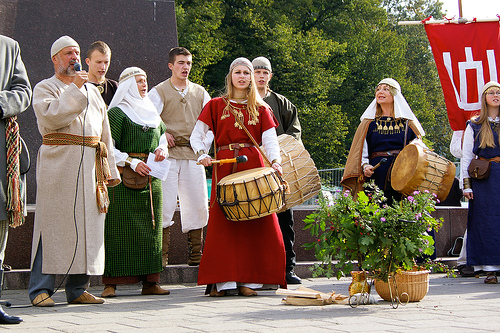 |
| A Romuvan religious festival. Image by Mantas LT. |
This is
another area where academic interest led to religious exploration, but it also
has a familial-ancestral component. My mother’s mother came to the USA from
Lithuania in the period of WW I, and I have always been interested to know more
of this obscure and mysterious little country that produced my maternal
ancestors. In studying Indo-European myth and religion, I became aware that
Lithuania has a unique status as the last European nation to convert to
Christianity, and one whose language has archaic features that make it among
the most closely related to Sanskrit, in terms of the Indo-European language
family. I also read works by Marija Gimbutas which further stimulated my
curiosity.
I went to
Iceland, as noted above, in September of 1996, but before that, in February of
the same year, I travelled to Lithuania for my first ever trip abroad. It was
amazing to see the country in transition from Communist greyness to a more
vivid form of life that celebrated its glorious past, as it was once one of the
great European empires, both before and during its alliance with Poland from
1386-1795. When I travelled to Lithuania in February of 1996, I knew of the
Pagan revival movement Romuva, and met the leader, the late Jonas Trinkūnas (1939 - 2014),
who received me kindly and became a friend and mentor. He invited me to come
speak at the inaugural meeting of the World Pagan Congress, soon to be renamed
the World Congress of Ethnic Religions (WCER) in Vilnius, Lithuania in 1998 as
an interested scholar, and I ended up participating in important discussions of
the nature and purpose of the organization, which led me to many contacts with
Pagans in different parts of Europe. I also attended and spoke at WCER meetings
in 2004 and 2005. I also developed connections with Latvian Paganism and
scholars that continue to the present.
[EDW]:
In 2005, ABC-CLIO published your edited volume, Modern Paganism in World Cultures: World Perspectives, as part of
their series on “Religion in Contemporary Cultures”. Containing contributions
from the likes of Sabina Magliocco, Jenny Butler, Jenny Blain, as well as
yourself, I personally think that it's a fantastic anthology, and that its
great importance lies in that in focuses on forms of contemporary Paganism
other than mainstream Wicca, instead looking at Druidry, Heathenry/Asatru,
Stregheria, Romuva, and Ukrainian Native Faith. In doing so, it clearly departed
from most previous publications in the field of Pagan studies, which had been
very much Wicca-centric and which had often presented a picture of Paganism in
which Wicca was seen almost as the normative case study for the movement. How
did you come to edit this particular volume, and what do you see as its success
and influence?
 |
| Book cover by ABC-Clio. |
[MS]: One of
the people on my dissertation committee, Frank Korom, great scholar of Indian
religion and folklore from Boston University, invited me to come up with an
idea for a volume on modern or neo-Paganism for a Contemporary Religion series
he was overseeing for ABC-CLIO. He gave me free rein, and very much influenced
by my Pagan contacts in Iceland, Lithuania and the WCER, I had a certain amount
of disdain for Wicca as a less-grounded-in-ethnic culture, made-up-by-Gerald Gardner form of modern Paganism, which is one reason for the book not having a
chapter on Wicca. I wasn’t anti-Wiccan, but I was simply not every interested
in it at that point. I have more respect for it nowadays as I have come to see
that every form of Paganism involves a certain amount of modern invention, and
that Wicca has blazed a trail for other forms of Pagan religion to follow. In
addition, I wanted to publicize interesting but little-known Pagan movements
other than Wicca, which had already had a fair amount of ink spilled on its
behalf.
[EDW]:
You are open about being a Pagan practitioner yourself, and run a blog titled
“The Political Pagan” in which you discuss many issues affecting the community
from what you have termed “a leftist-liberal” perspective. What do you perceive
as the importance of this venture, and of political activism within the Pagan
movement itself ?
As noted
earlier, the blog grew out of my personal frustrations with the largely conservative
political orientation of American Ásatrú and a desire to discuss the issues
involved and advocate for something more “liberal” and “leftist” with a larger
audience. I see what I am attempting
here and what others are attempting in other ways, in other venues, as a battle
for the heart and soul of Paganism. There is a very real tendency that
constitutes a very dangerous temptation in many Pagan movements based in
European myth and folklore to turn toward racism, even if a veiled form of
racism, with an interpretation of European-derived Pagan heritage in
essentially racist terms, seeing it as something that not only came from
Europe, but is meant only for people of European descent, and which must be
protected from mixing with peoples or traditions of non-European pedigree.
 |
| Dr. Strmiska's blog, "The Political Pagan". |
My viewpoint
is that there are beautiful folkloric and mythological elements of European
culture—just as in other regions and culture-zones—that have a spiritual
dimension which can provide a wonderful platform for modern (or should we say,
post-modern) forms of religion, that can be relevant to modern (or post-modern)
peoples for many reasons, out of which I would highlight two. Such a religion
can provide a connection to the past and to cultural heritage, for those for
whom that is meaningful or desired, and can also help connect spirituality to
celebration and preservation of nature.
So I see a possibility of striking a balance between an ethnic heritage
dimension and an environmental one. Note that I say, provide a platform, in
that I see ancient ethnic traditions as
a floor, a basis, a starting point, NOT a ceiling, NOT an absolute
limit. We take inspiration from the past and use old traditions to shape tools
and perspectives to help us cope with the present and build for the future. And
part of that has to be recognition of cultural and ethnic diversity AND
cultural and ethnic mixing. There are problems with all of this, contradictions
and pitfalls, but I am hoping to help articulate a forward-looking Paganism
that has roots in the past, but is open to the future.
[EDW]:
Have you got any other projects on the horizon that we should keep our eyes out
for ?
[MS]: In 2010,
I presented a paper at the American Academy of Religion annual conference
entitled “Transatlantic Tensions in Norse Paganism: Left-Wing/Right-Wing
Tendencies in America and Europe.” It included a survey of political attitudes
among American Ásatrú followers which verified my hunch that the general
political tendency in this population was conservative-libertarian. I have
since conducted a similar survey among Ásatrú members in Iceland, and have
plans to duplicate this in Sweden and maybe also Czech Republic, which does
have Norse-Germanic Pagan groups along with Slavic and Celtic ones. When I
finally finish the surveys, I will revise the conference paper noted above and
probably publish several different versions, very likely in the Pomegranate or
Nova Religio if not elsewhere. I am thinking about collecting my various
Ásatrú-related articles into a book, also.
My main book
project since 2010 has been something broader and more ambitious than my
research on modern Paganism: a book entitled Unchristian Eastern Europe:
Pagans, Jews and Gypsies, which will look at the presence and contributions of
various non-Christian groups from Pagans to Jews to the Roma (Gypsies) and
possibly also Tatars and Muslims to the social, cultural and spiritual fabric
of Eastern European life over the centuries, from the Roman period onwards. I
have spent much of the last four summers researching and writing the Jewish
section, which will be the longest part of the book. It has been fascinating to delve into the
history of Kabbalism, Hasidism and the Haskalah, as well as controversial rebel
Jewish leaders, Shabbetai Zevi and Jacob Frank. As I am not competent in the
languages of many of the regions, groups and cultures I am dealing with, from
Lithuania and Latvia in the Baltic region of Eastern Europe to the Poland, the
Czech Republic and Hungary in the more central part of Eastern Europe, this
will be a somewhat derivative work, drawing mightily on secondary sources
written in or translated into English.
The
originality of the work will be its juxtaposition of Jew, Roma, Pagan and
others, to demonstrate that Eastern Europe is NOT— and has never been—simply or
wholly Catholic, as many have said of Poland, or strictly or exclusively
Orthodox, as is often thought of Russia, but that alongside and underneath the
Christian forms of religious thought and culture that have long dominated
Eastern Europe, there run separate and subterranean streams of tradition and
spirituality. That is to say, I want to make a historical case for Eastern
Europe as a zone of religious and cultural diversity, and then move on to a
final part of the book that will be rather tricky, but hopefully productive.
This will be to note that Eastern Europe has lost some of this diversity in the
last few centuries, with the rise of ethno-nationalism in the nineteenth
century pushing for single-ethnicity nation states, with the exclusionary,
jingoistic logic of “Poland for the Poles,”
“Hungary for the Hungarians,”
“Lithuania for the Lithuanians,” and so on. The most awful form of this
impulse was of course the Third Reich with its mass exterminations of Jews,
Roma and, to a lesser extent, Slavs, in favor of a single-ethnicity German
Empire. This still lives on today in the continuing cruelty inflicted on the
Roma across Eastern (and Western) Europe, reviving patches of anti-Semitism
here and there, and a new phenomenon of anti-Islamism. My final analysis will
ask the question, where should Eastern Europe go from here? To reclaim the
cultural and religious diversity of the past, evident in such political
groupings as the Grand Duchy of Lithuania, the Polish-Lithuanian Commonwealth,
the Austro-Hungarian Empire, or to continue the process of ethno-nationalist
narrowness and exclusion? To reach out to Roma and immigrant Muslims, or seek
to expel or exterminate them? To revive ideas of Christianized versions of
national identity that favor the suppression of minority and alternative
religions, or embrace religious diversity and let go of Christian domination?
Along with religious diversity comes cultural and social diversity, of course.
Paganism,
while not being a majority religion anywhere in Eastern Europe, though
surprisingly strong in supposedly totally Catholic Poland, and also present in
the supposedly thoroughly non-religious Czech Republic, has an interesting role
to play in this debate. It is often imbued with ethno-nationalistic pride and
impulses, and it too must struggle with diversity, including acknowledging
Christianity as a valid and enduring religion and noting that Christianity has
absorbed a fair number of Pagan elements over the centuries. How Paganism
negotiates its position in Eastern European countries will, I think, be
something of a bellwether for the overall direction of Eastern Europe either
toward a positive embrace of diversity and an expanding sense of common
humanity across ethnic and religious boundaries, or a poisonous turning inwards
toward ethnic narrowness and social exclusion.
I envision
this book being a useful undergraduate text for courses on Eastern European
history or European diversity. It is a massive project that exceeds my
capacities, but isn’t that the best kind of project to work on? Teaching at
Masaryk University in the Czech Republic this fall, NOT in Prague but the much
less crowded, far more cozy, and far less expensive city of Brno, which is just
two hours north of the great Hungarian metropolis of Budapest, I hope to have
time to write and ample opportunity to meet with Czechs and Hungarians of
different sorts: Pagans, Jews, Gypsies and others! There is, for example, a
Roma-Buddhist organization in Hungary that I learned of several years ago
called Ja Bhim. It sought to empower young Roma with a more positive sense of
identity by focusing on the ancient Indian roots of the Roma and then
highlighting Buddhism as a form of religion opposed to all social exclusion. Ja
Bhim was operating schools for young Roma, with some success, but fell afoul of
the right-wing Hungarian national government and lost funding. I have lost
track of this group but hope to visit them and learn more. This is the kind of
thing I hope to look into while in the region and include in my book.
[EDW]:
Having been actively involved in the academic field of Pagan studies for a
decade and a half now, I'd like to ask you where you thought that it was
heading, particularly given the threats that it faces from university funding
cuts. On a related note, how do you think that the field will cope given that
it has come under criticism from Markus Altena Davidsen for working under a
religionist perspective that places too great an emphasis on emic perspectives
? In particular, what do you see as the future for the study of Paganisms
rooted in Northern, Central, and Eastern Europe that embrace a national or
ethnic approach to the movement ?
[MS]: I think
Pagan Studies is entering a renaissance, with new scholars coming on board who
are theoretically grounded, ethnographically talented and methodologically
astute. As examples, let me mention two books that I consulted on and which
have been published in the last several years, Mariya Lesiv’s The Return of Ancestral Gods: Modern Ukrainian Paganism as an Alternative Vision for a Nation (Montreal: McGill
University Press, 2013) and Jennifer Snook’s American Heathens: The Politics of Identity in a Pagan Religious Movement (Philadelphia: Temple University Press, 2015). Both volumes show a
growing maturity in thought and method for our little sub-field, combining fine
ethnographic fieldwork with deep historical understanding and probing
sociological analysis. [EDW: Having read both works over the past year, I would
strongly recommend that Albion Calling readers check them out!]
As to
Davidsen’s “scandalous” broadside against Pagan Studies, I do not see the need
to over react. He clearly has not seen ALL Pagan Studies scholarship, or he
would not have made the sweeping and dismissive generalizations that he did, but he
did raise some valid points that are constructive to consider, such as a
possible over reliance on the emic point of view. I myself made some similar
criticisms back in 2005 in a review of Researching Paganisms, a volume of
methodological essays edited by Jenny Blain, Douglas Ezzy, and Graham Harvey [EDW: The latter interviewed here back in February 2014]. I argued then
that overuse of one’s own personal Pagan history as a point of reference or
focus of discussion could be a problem if it prevents a more balanced view of
the situation that would or should take in others’ views both inside and
outside the religious group under discussion. Too much emic can be a bad thing,
and I would indeed agree with Davidsen on that. However, I don’t agree with
what he seems to propose as a corrective to an emic overload, which, as far as
I understand his thinking, is a return to a rather stale, old-fashioned,
outmoded, “totally objective,” strictly etic form of observation and analysis
which robotically reports “scientific” facts and eschews any discussion of the
personal viewpoint and position of the writer. That is going too far the other
way, in my opinion. I think good scholarship on modern Paganism or any other
form of living religion or indeed any social phenomenon should engage with both
the emic and the etic side of things, which creates a productive if at times
uncomfortable tension that is well worth the trouble.
I do feel that
is entirely valid and indeed very valuable for an author of a Religious Studies
article to declare their personal religious viewpoint, whether Pagan,
Christian, Rastafarian or whatever else. When this is included, the reader can
keep that in mind when trying to understand and appreciate the author’s
presentation of the religious group under discussion, and be better informed of
the overall situation. However, I caution against scholars getting lost in
personal reflections of their own experience to where all they talk about is
themselves. If you feel that need, go write your autobiography! “Now it can be
told….!” Our personal religious experience is a valid piece of data to include
in a Religious Studies analysis, but it should be just one datum among others.
I also
realize, and think it very important to point out, that for some young and
budding scholars who are just now coming up the path in their academic careers,
it may be professionally and personally injurious for them to declare a Pagan
affiliation of any sort in any published work or public venue, and allowance
should be made that sometimes. It is simply not possible for every writer on
Pagan topics to describe their personal religious situation or identity. We do
want Pagan Studies scholars to be able to gain academic employment and
contribute to Religious Studies from positions of strength and security, and in
a world where Paganism is a tiny religious minority, asking every Pagan to
“come out” and be vocal about their personal religiosity may be more
counterproductive than constructive.
There is
growing Pagan Studies and New Religious Movement scholarship in Central and
Eastern Europe, and I have met a good many fine scholars there, in Lithuania,
Latvia, Poland, the Czech Republic and Hungary. On a personal note, I was very
much moved when I visited the Czech Republic in 2012 and found that portions my
book Modern Paganism in World Cultures had been translated into Czech and
circulated on the internet there, virtual samizdat style, and was being read
with interest by both scholars and practitioners of Paganism. This is one
reason I am going to the Czech Republic!
Overall, I
think Pagan Studies is doing fine, and debates and discussions of proper
method, focus and scope such as were advanced by Davidsen are to be welcomed,
even if we do not always like the tone or style of approach. We are a young
field, and we will no doubt do well to listen and respond to intelligent
questions and critiques as we find our way forward.
I also feel
strongly that Paganism will also continue to grow in many different forms, and
I worry deeply about the divide between the more “right-wing” ethnic-tribal
Pagans and the more “left-wing” open-universalist and environmentally-oriented
ones: Stephen McNallen versus Starhawk, as it were. Obviously, this has become
my main preoccupation in my own studies of and involvement in Paganism. It
should be noted, however, that all religions face these splits and variations,
and this could even be taken as a measure, albeit a sad one, of the growing
maturity of the Pagan movement. Consider, in the American context, the
pro-slavery Southern Christians of the past versus the Civil Rights leaders that
grew out of the African-American Christian community in the 1950s and 1960s.
Consider the historical split between Sunnis and Shi’ites still roiling the
Muslim world and generating fresh bloodshed today, as well as the frequent
persecution of Sufis, or the divide between Orthodox Christians and Old
Believers in Russia, or that between Protestants and Catholics in Ireland. The
founders of Hasidism in the late 18th century were beaten and thrown into
prison—by other Jews.
Religion is
always a fight.
[EDW]:
Dr. Strmiska, thank you very much for your illuminating comments here at Albion
Calling – I wish you all the best with your forthcoming time in the Czech
Republic and your forthcoming projects!


